
European Economic
and Social Committee
Revitalising EU economic governance: EESC's vision for success
The European Economic and Social Committee (EESC) has presented a set of crucial recommendations in response to the Commission's proposed legislative package reforming the European Union's economic governance framework. While the EESC appreciates the intention of simplifying the framework, it advocates for critical adjustments to the proposal. These recommendations come at a pivotal moment, underlining the need for a balanced, adaptable, and sustainable approach to economic governance within the EU.
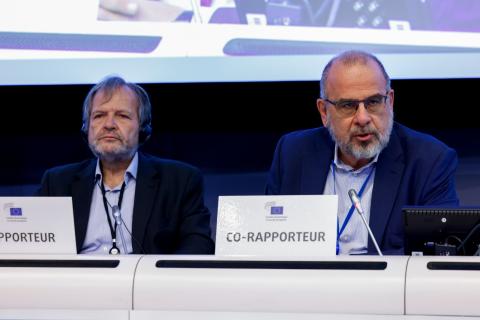
As the EU grapples with some formidable challenges – including recovering from the COVID-19 pandemic, navigating geopolitical complexities, and pursuing ambitious climate objectives – EESC rapporteur Javier Doz Orrit stresses, The EESC says yes to fiscal and structural plans negotiated with national governments, but without rigidities, and with more involvement of national democratic institutions and organised civil society. We propose a reflection to overcome the limitations of the Commission proposal: a permanent fiscal capacity for the EU and a deeper economic governance.
While the EESC welcomes certain positive aspects of the proposed legislative package, such as the simplified and more transparent framework, the reduction of pro-cyclical biases, and the strengthening of national ownership, it also highlights the pressing need for substantial adjustments.
Co-rapporteur Luca Jahier: We call for prompt negotiations among the co-legislators to adopt the proposed legislative package before the next EU election. We seek a balanced, enforceable, and predictable economic and fiscal governance framework. While we support the Commission's proposal in principle, we have concerns about added constraints, heightened national responsibilities, and the need for structured civil society involvement.
Reforming fiscal adjustment requirements and sanctions: a new approach for Member States
One key proposal is that the existing rule requiring any Member State with a budget deficit exceeding 3% to reduce it by an average of 0.5% of GDP annually should be replaced with a more flexible approach that considers each country's unique circumstances. The EESC also contends that automatic sanctions under the Excessive Deficit Procedure, primarily based on public debt ratios, should be reconsidered. Furthermore, the Committee emphasises that the "technical trajectory" (i.e. the path for the Member State's net primary public expenditure for the adjustment period of the fiscal-structural plan) should primarily be determined by national governments, in consultation with independent national fiscal bodies, thus enhancing national ownership of the process. Subsequently, a technical dialogue with the European Commission could further refine this trajectory. These recommendations aim to establish a fairer and more adaptable fiscal framework for all Member States.
Redefining public investment in EU fiscal procedures
The EESC proposes important changes in how public investment is handled, recommending for example that investment in common priorities like the green transition and defence should be treated differently when deciding whether any excessive deficit procedure should be opened. The EESC also suggests broadening the definition of public investment to also include investing in nature and people, such as environmental and social projects. Additionally, the Committee proposes creating an EU fiscal capacity by 2026 to support these investments and help Member States manage the costs of various transitions that may not qualify as investments. The idea is to ensure that the EU can effectively address its common goals and challenges.
Inclusive governance
The EESC reaffirms the critical importance of involving social partners and civil society organisations in the upcoming regulations. It stresses the need for permanent and well-structured consultation processes throughout the various phases of the emerging economic governance framework. Furthermore, the EESC calls for both itself and the Committee of the Regions (CoR) to be actively involved in the "Semester dialogue". Finally, it underscores the pivotal roles that both national and European parliaments should assume within the EU economic governance framework to enhance democratic accountability.
Work organisation
Recommended for you
Skrajni čas za vlaganje v mlade na Zahodnem Balkanu
News
Da bi vlade držav Zahodnega Balkana svojim državljanom zagotovile boljšo prihodnost, se morajo lotiti reševanja težav, s katerimi se srečujejo mladi, ki imajo ključno vlogo pri njenem ustvarjanju.…
Vaša Evropa, vaš glas! v letu 2023: Mladi si želijo, da bi bila EU preglednejša, bolj digitalna in enostavnejša
News
Evropski ekonomsko-socialni odbor (EESO) je 23. in 24. marca gostil dogodek Vaša Evropa, vaš glas! Potekal je v Bruslju, udeležilo pa se ga je 105 dijakov 35 šol iz vseh 27 držav članic EU in sedem…
Začetek zbiranja prijav za nagrade za civilno družbo EESO na temo duševnega zdravja
News
Organizacije civilne družbe, posamezniki in zasebna podjetja lahko svoje nepridobitne projekte prijavijo za nagrado EESO, namenjeno spodbujanju duševnega zdravja Evropejcev Evropski ekonomsko…
Oddajte svoj glas junija 2024: EESO poziva Evropejce, naj volijo za enotno in demokratično Evropo
News
Demokracija po vsem svetu nazaduje, širijo se dezinformacije in vse več je nezadovoljstva zaradi naraščajoče inflacije ter preteče nevarnosti vojne, zato so letošnje evropske volitve, na katerih bodo…
Ohranjanje zagona širitve EU: prizadevanje civilne družbe, da bi s postopnim vključevanjem prinesla koristi Zahodnemu Balkanu
News
Evropski ekonomsko-socialni odbor (EESO) je 20 let po pristopu Slovenije k EU v Ljubljani zbral politične voditelje in voditelje civilne družbe, da bi obeležili to simbolično obletnico in poudarili…