emphasises the urgent need to enhance European competitiveness while maintaining sustainability and social cohesion. The EU must act decisively to stay competitive without compromising environmental sustainability, workers’ rights or regional balance. The EESC advocates for growth aligned with social and territorial cohesion;
calls for greater investment in key areas such as social infrastructure, digital transformation and energy transition. The EESC emphasises the need for substantial investments in modern infrastructure - education, research, digitalisation and renewables - to sustain Europe’s economic strength and competitiveness and tackle demographic, technological and climate challenges;
stresses the need for the EU to drive global economic transformation rather than just preserve past achievements. Europe is at a crossroads: it can either take a proactive role in global economic transformation or risk falling behind. The EESC therefore calls for the proactive adaptation of the single market, reduced reliance on non-EU supply chains and stronger strategic industries.
On 8 June 2022 the Consultative Commission on Industrial Change (CCMI) celebrated its 20th anniversary with a conference focused on the challenges of today and the prospects for tomorrow. This publication is a record of the occasion and a commemoration of what CCMI has achieved since joining the EESC.
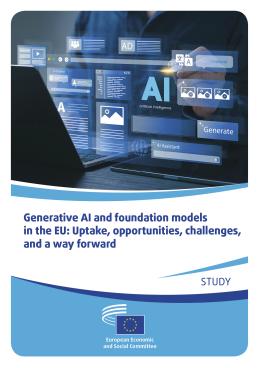
Exploring the evolving landscape of generative artificial intelligence (GenAI) within the European Union, this study delves into technological advancements, market dynamics, and regulatory challenges. It highlights the EU’s position in the global GenAI ecosystem, revealing significant US dominance, while uncovering sector-specific opportunities and risks across industries such as automotive, renewable energy, and education.
Given the significance of the provision of public goods for the well-being of the citizens, the EESC believes that particular attention should be paid to providing these European public goods (EPGs) and identifying them in the next multiannual financial framework (MFF) post-2027.
Special attention must be given to ‘functional EPGs’ – those linked to Article 3 TEU – that can ensure the normal functioning of the EU: the completion of the single market; the completion of the economic and monetary union; economic, social and territorial cohesion; EU open strategic autonomy (e.g. the joint EU health policy, food security, the EU energy union); defence and security; EU research and development; and the rule of law.
The EESC assesses how the EU’s sustainable finance framework can be made more robust and fit for purpose given its importance for the EU’s economic, social and climate objectives. The EESC affirms that simplification should not come at the cost of ambition. While administrative streamlining is needed, the focus should be on how requirements can be implemented more effectively, not on weakening standards. The EU’s regulatory strength and predictability are important competitive advantages that should be preserved amid growing geopolitical and economic uncertainty.
Expanding across borders in the EU means navigating a maze of conflicting VAT rules and paperwork, driving up costs. Small and medium-sized enterprises (SMEs), in particular, face disproportionate compliance burdens, making it harder to scale up and compete. To cut red tape and boost competitiveness, the EESC calls for urgent reforms in two opinions adopted during its February plenary, building on the Letta and Draghi reports. Proposals include harmonised financial regulations, AI-driven reporting and a coordinated industrial policy.
Innovation is the real driver of growth and the key to creating employment, developing novel technologies and finding new solutions to tackle the challenges we face today and thus to increase competitiveness