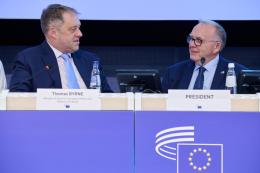
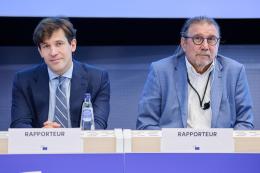
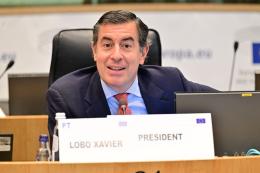
Water resilience requires stronger cooperation, recognition of access to affordable water as a universal right, and a more effective multilateral framework. The EESC brought together civil society actors to help shape the EU contribution to the 2026 UN Water Conference.
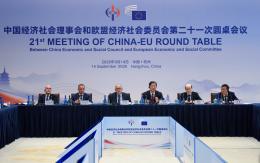
The European Economic and Social Committee (EESC) called for a balanced, forward-looking and people-centred approach to EU-China relations, stressing the need to address growing trade imbalances, strengthen efforts to combat poverty, promote trustworthy and human-centred artificial intelligence, and maintain an open dialogue on human rights.
On Tuesday 8 September 2026, European Economic and Social Committee (EESC) President Séamus Boland welcomed European Commissioner for Enlargement Marta Kos to his family farm in Ballycumber, County Offaly, for discussions on EU enlargement and the essential role of civil society in preparing candidate countries for membership. The meeting took place during Commissioner Kos's visit to Ireland for the EU Council Presidency meetings of foreign affairs and European affairs ministers in Wicklow and Dublin.
European Economic and Social Committee (EESC) President Séamus Boland today welcomed European Commissioner for the Environment, Water Resilience and a Competitive Circular Economy Jessika Roswall to his family farm in Ballycumber, County Offaly, to discuss sustainable farming, biodiversity and the future of rural communities.
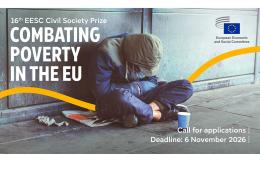
Civil society organisations, individuals and private companies can now enter their non-profit projects for the EESC’s prize dedicated to combating poverty in the EU.
In an increasingly unstable geopolitical environment, EU enlargement is a strategic investment for Europe's security. Faster socio-economic convergence with the EU can boost growth, strengthen competitiveness and deliver real benefits for citizens. These were the key messages of a high-level debate at the EESC with the European Commissioner for Enlargement and representatives from candidate countries.
Dezbaterea cu membrii CESE, care a avut loc în cadrul sesiunii plenare din iulie, a demonstrat fără echivoc că programul actualei președinții a UE răspunde pe deplin preocupărilor și așteptărilor societății civile organizate din Europa.
The European Economic and Social Committee (EESC) held a plenary debate with European Commission Executive Vice-President, Roxana Mînzatu, on how better protection for workers can strengthen Europe’s competitiveness. The debate focused on quality jobs and fair labour mobility, and was followed by the adoption of two related EESC opinions.
Undermining democracy will not make the European Union more competitive. In an increasingly challenging geopolitical landscape, building resilience to disinformation, fostering critical thinking and empowering civil society are essential to safeguarding European values, an EESC conference for civil society communicators concluded
The European Semester must evolve into a more results-oriented framework that promotes sustainable competitiveness and social inclusion while ensuring that reforms and investments deliver tangible benefits for citizens. This is even more crucial given its future link to the next Multiannual Financial Framework. This was the central message from the Annual European Semester Group Conference, held by the European Economic and Social Committee (EESC) in Brussels on 30 June.