
European Economic
and Social Committee
Candidate countries are key to Europe's security, stability and prosperity
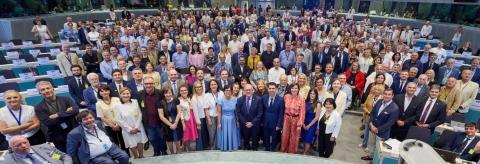
In an increasingly unstable geopolitical environment, EU enlargement is a strategic investment for Europe's security. Faster socio-economic convergence with the EU can boost growth, strengthen competitiveness and deliver real benefits for citizens. These were the key messages of a high-level debate at the EESC with the European Commissioner for Enlargement and representatives from candidate countries.
On Thursday 16 July 2026, the European Economic and Social Committee (EESC) and the European Commission hosted a high-level debate during the EESC plenary session to discuss the challenges and opportunities of the enlargement process and to take stock of the Enlargement Candidate Members (ECMs) initiative. Political leaders and ECMs explored how enlargement can strengthen Europe's security, resilience and competitiveness.
Opening the debate, EESC President Seamus Boland stressed that enlargement is both a political project and a means of delivering real benefits for citizens: 'By advancing democratic reforms, as well as strengthening the rule of law and fundamental rights, candidate countries are contributing to our shared European security. Accelerating socio-economic convergence is essential for enlargement to deliver tangible benefits for citizens.'
Participants agreed that enlargement is a strategic investment in Europe’s future. They also emphasised that reforms are more effective and sustainable when social partners and civil society organisations are involved at every stage.
Marta Kos, European Commissioner for Enlargement, underlined that enlargement has returned to the top of the EU agenda, reshaping Europe’s political and security architecture and strengthening its ability to compete with other major global powers. Referring to Ukraine, she noted: 'When the war ends, it will be a country that has prevailed against Russia in an existential war. It will be among Europe’s strongest military powers, with expertise that no one else has. Next to security, there is also a compelling economic case. Every previous enlargement has been an economic success story.'
In a video message, David McAllister, Chair of the European Parliament's Committee on Foreign Affairs, reaffirmed the Parliament's support for enlargement as an investment in Europe's collective future and highlighted the importance of democracy, the rule of law and fundamental rights in the accession process.
Paying tribute to the EESC's support of EU enlargement through the presence of candidate countries in the institution, the Republic of Moldova's Deputy Prime Minister and Minister of Foreign Affairs, Mihai Popșoi, noted that governments and civil society may not always agree, but that such debate is a hallmark of a healthy democracy. He stressed that protecting democracy is a shared responsibility.
Panellists emphasised the vital role of civil society, including NGOs, in strengthening Europe's resilience. Nerijus Aleksiejūnas, Lithuania's ambassador to the EU, warned that EU cannot afford "grey zones" in its neighbourhood and that any vacuum would quickly be filled by competing powers.
Addressing socio-economic convergence, Zulfi Ismaili, North Macedonia’s ambassador to the EU, stressed that European integration was also a practical necessity, as 70% of his country’s trade is with the EU - a factor driving swift reforms.
The debate showcased the value of the EESC's ECM initiative, in bringing civil society representatives from candidates and potential candidates closer to EU policymaking. Participants reaffirmed that the future of the Western Balkans, Ukraine, Moldova and all countries committed to the European path lies in a united Europe and that successful enlargement depends on active civil societies as well as governments and institutions.
Additional quotes
'For businesses, enlargement is an investment in Europe’s future: when done well, it brings stability, connectivity and prosperity for citizens and businesses alike.'
Sandra Parthie, EESC Employers' Group president.
'EU enlargement is not just about borders; it is also about dignity and fairness. Trade unions must be equal partners in strengthening reforms in the candidate countries.'
Lucie Studničná, EESC Workers' Group president.
'Europe's resilience will not be built by institutions alone. Civil society must be a partner in preparedness from the outset, helping to build trust, strengthen communities and mobilise citizens.'
Ariane Rodert, EESC Civil Society Organisations Group vice-president and rapporteur of the opinion on the Union Preparedness Strategy.
Background
In September 2023, the EESC launched the Enlargement Candidate Members initiative (ECM), a landmark step aimed at involving representatives of employers, trade unions and civil society organisations from EU candidates and potential candidates (Albania, Bosnia and Herzegovina, Georgia, Kosovo*, Moldova, Montenegro, North Macedonia, Serbia, Türkiye and Ukraine) in its advisory work. *This designation is without prejudice to positions on status and is in line with UNSCR 1244 and the ICJ opinion on Kosovo Declaration of Independence.
ECMs participate throughout the drafting process of selected EESC opinions and contribute to study groups. They also take part in EESC section meetings and plenary sessions, where the Committee formally adopts its opinions.
EESC opinion, adopted in April 2026: Civil Society’s Role in Supporting Reform under the Growth Plans for the Western Balkans and Moldova, as well as in Ukraine’s Reform Path
Work organisation
Downloads
-
Candidate countries are key to Europe's security, stability and prosperity
-
Les pays candidats sont essentiels à la sécurité, à la stabilité et à la prospérité de l’Europe
Recommended for you
In search of European prosperity innovation is key
News
Article by Stefano Mallia (President of the EESC Employers' Group) and Pieter Timmermans (CEO of the Federation of Belgian Enterprises)Economic growth is driven by innovation, modernization and…
A prosperous Europe is an autonomous and open Europe
News
The EESC held a conference on the future of European strategic autonomy. The event was organised jointly by three Committee bodies; the Digital Transition and Single Market Observatory, the Labour…
Candidate Countries Commend EESC for Elevating Civil Society in Enlargement Process
News
At an Enlargement Forum hosted by the European Economic and Social Committee (EESC), civil society representatives from candidate countries commended the Committee’s Enlargement Candidate…
The importance of institutionalising civil and social dialogue in EU candidate and partner countries
News
BackgroundThe EESC underlines the clear distinction between social dialogue (as enshrined in Articles 151 – 155 in the Treaty on the Functioning of the EU) and involving social partners (employers’…
Civil Society for democracy in candidate countries
Agenda
Webstreaming 04/52 . Back to Agenda Draft Agenda 16:15-16:25 Introduction by Ionut Sibian, EESC member of the REX section, Executive Directive of the Civil Society…