
European Economic
and Social Committee
From Resistance to Renewal: Europe and Ukraine Building a Shared Future
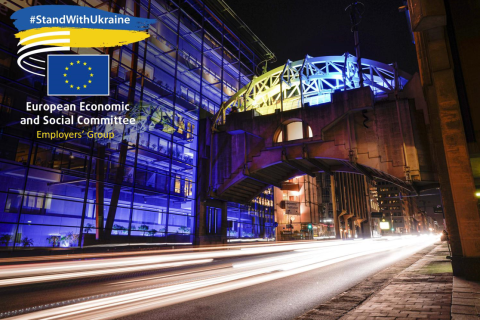
This month marks four years since Russia launched its full-scale invasion of Ukraine, four years of devastation but also of courage, resistance and unbroken resolve from the Ukrainian people.
What began as an attempt to erase a sovereign nation has become a defining test of Europe’s unity and of our shared commitment to peace, freedom and democracy. This anniversary invites not only remembrance, but a renewed determination to support Ukraine on its path to victory, recovery and European integration.
From the very first day of the invasion, Europe has stood firmly by Ukraine. Financial and military assistance have enabled the country to keep its institutions functioning, its public services running, and its economy alive despite the brutality of war. Opening the EU Single Market to Ukrainian goods and services has been one of the clearest expressions of this solidarity. By keeping trade flowing, it has supported employment and allowed Ukrainian businesses to start integrating into European value chains, sending a powerful message: recovery begins with partnership, and Ukraine’s future lies within the European family.
This partnership has not been built by institutions alone. Under our former President Stefano Mallia, our Group quickly reached out to Ukrainian business partners, proving that reconstruction is driven by human relationships — employer to employer, business to business, society to society. These links of trust and cooperation form the backbone of Ukraine’s long-term integration and recovery. They show that every company, every organisation and every citizen can play a role in rebuilding a free and prosperous Ukraine.
As we mark this fourth anniversary, we must look ahead with the same clarity and determination that guided our initial response. Solidarity remains essential, but it is no longer sufficient on its own. Europe must work more actively towards a credible and lasting peace settlement, because political predictability and security are the foundations on which reconstruction and private investment can truly thrive. Only in a stable environment can Ukrainian entrepreneurs, investors and workers fully unlock their potential.
Translating commitments into concrete action is now our most urgent task. Fully operationalising the Ukraine Facility, and in particular its investment pillar, will be crucial to mobilising blended finance and opening new opportunities for both public and private partners. The same sense of urgency applies to the energy sector. By integrating Ukraine’s energy market with that of the EU, and by investing in grid connections and cross‑border capacity, we can support industrial recovery while also strengthening Europe’s own energy security.
Russia’s continued targeting of civilian and energy infrastructure, especially during harsh winter months, is a stark reminder that this war is waged not only on the battlefield but also against the daily lives and dignity of millions of people. Supporting cooperation in the defence industry to reinforce Ukraine’s resilience, while enhancing Europe’s security, has therefore become an urgent priority. At the same time, investing in connectivity -- roads, railways, borders and digital networks that link Ukraine with the European Union — is vital to sustaining trade, mobility and the logistics of reconstruction.
As we deepen this work, we must also reaffirm our unwavering support for Ukraine’s path towards EU membership. The European Economic and Social Committee was the first EU institution to publicly endorse this objective, and we uphold it today with the same conviction. Ukraine belongs in the European Union politically, economically and in spirit. Four years on, the courage of the Ukrainian people continues to inspire us all, reminding us that freedom, when defended together, does not merely survive — it grows stronger and endures.
By Sandra Parthie, President of the Employers' Group.
Recommended for you
Il-KESE jappella għal regolamentazzjoni b’saħħitha u ssemplifikata tal-kriptoassi
News
Il-Kumitat Ekonomiku u Soċjali Ewropew jappoġġja żieda fir-regolamentazzjoni tal-kriptoassi, b’regoli robusti u koerenti biex l-investituri fl-UE jiġu protetti aħjar, f’konformità mal-miżuri attwali…
L-istrumentalizzazzjoni tal-migranti u l-kriżi tar-refuġjati tal-Ukrajna jappellaw għal bidu ġdid għall-politika dwar il-migrazzjoni
News
L-istrumentalizzazzjoni tal-migranti sostnuta mill-Istat, li għandha l-għan li tiddestabbilizza lill-UE, u l-gwerra attwali fl-Ukrajna, li wasslet għal influss bla preċedent ta’ refuġjati, jagħmluha…
“L-Ewropa Tiegħek, Leħnek” 2023: Iż-żgħażagħ jitolbu UE aktar trasparenti, diġitali u semplifikata
News
Fit-23 u l-24 ta’ Marzu, il-Kumitat Ekonomiku u Soċjali Ewropew (KESE) ospita l-14-il avveniment L-Ewropa Tiegħek, Leħnek!, li laqqa’ fi Brussell 105 studenti minn 35 skola mis-27 Stat Membru tal-UE…
Euro-Med – L-organizzazzjonijiet tas-soċjetà ċivili huma essenzjali biex l-ekonomija u s-soċjetà jaħdmu tajjeb
News
Matul is-sessjoni plenarja ta’ Diċembru tal-Kumitat Ekonomiku u Soċjali Ewropew (KESE) sar dibattitu dwar ir-rikostruzzjoni u r-reżiljenza tar-reġjun Ewro‑Mediterranju wara l-pandemija tal-COVID-19.…
Il-KESE jiftaħ l-applikazzjonijiet għall-Premju tiegħu għas-Soċjetà Ċivili li se jkun qed jindirizza s-saħħa mentali
News
L-organizzazzjonijiet tas-soċjetà ċivili, l-individwi u l-kumpaniji privati issa jistgħu jdaħħlu l-proġetti tagħhom mingħajr skop ta’ qligħ għall-premju tal-KESE ddedikat għall-appoġġ tal-benesseri…