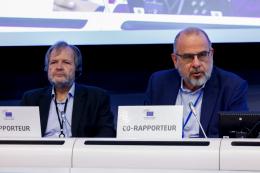
The European Economic and Social Committee (EESC) has weighed in on the EU's proposal to regulate environmental, social and governance (ESG) ratings. In an opinion adopted in October 2023, the EESC emphasises the need for quality standards to combat greenwashing and advocates the mandatory inclusion of the principle of double materiality. The definitions of "ESG ratings" and "ESG rating providers" need to be refined to exclude certain non-commercial activities from the regulation's scope. Additionally, the Committee recommends establishing an EU sustainability agency.
Despite many recent breakthroughs and the fact that the EU gender equality index reached record levels this year, much still needs to be done for women to achieve equal rights as men in many domains
Highlights of the European Economic and Social Committee's October plenary. The EESC will host the following debates: 25 Oct, 15.00 hrs: Gender equality as part of Gender Equality Week, 26 October, 10.45 hrs - "Call for an EU Blue Deal – a comprehensive water strategy for Europe"
On 17 October the EESC'S External Relations Section (REX) held a debate on the impact of the climate crisis on gender equality. Gender inequality linked to the climate crisis is one of today's greatest challenges. The European Union and United Nations Women, the biggest players in international community, should continue to work together on this issue.
I am truly appalled by the horrible terrorist attacks carried out by Hamas against Israel. As the President of EESC, I strongly condemn these acts of terror and violence against innocent people, a true crime against humanity. The European Economic and Social Committee remains fully united with the citizens of Israel and their civil society.
Statement by the members of the EESC Euromed Follow-up Committee participating in the EESC-Spanish ESC conference on "Climate change and migration in the Mediterranean" in Alicante on 11 October 2023.
In an opinion adopted at its September plenary session, the European Economic and Social Committee (EESC) took a closer look at the European Integrated Border Management Strategy (EIBM), emphasising the need for a shared strategy, improved coordination, and fundamental rights protection in European border management.
The European Economic and Social Committee (EESC) underscores the pivotal role of promoting healthy and sustainable diets in enhancing human health, preserving ecosystems, strengthening society, and supporting rural communities.
The European Economic and Social Committee (EESC) calls for more joint actions on EU Maritime Security Strategy and its Action Plan which aim at preserving EU sovereignty, security and competitiveness. The Committee supports the EU-NATO cooperation on maritime security and signals the importance of firm engagement with international partners to collectively tackle people smuggling and human trafficking.
The European Economic and Social Committee (EESC) has presented a set of crucial recommendations in response to the Commission's proposed legislative package reforming the European Union's economic governance framework. While the EESC appreciates the intention of simplifying the framework, it advocates for critical adjustments to the proposal. These recommendations come at a pivotal moment, underlining the need for a balanced, adaptable, and sustainable approach to economic governance within the EU.