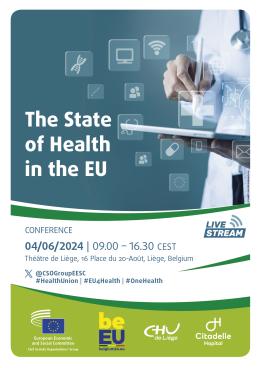
Conference in the framework of the Belgian presidency of the Council of the European Union
Event type
Conference
Location
16 Place du 20-Août
Liège
Belgium
The Civil Society Organisations' Group organised this conference in partnership with the Centre Hospitalier Universitaire de Liège and the Hôpital de la Citadelle.
Our members present their ideas for the future of health policy in the EU
Guest articles by Marc De Paoli (Managing Director, Liège University Hospital), Sylvianne Portugaels (Director-General, Citadelle Hopital) and Martyna Kowacka (Chief Commissioner, Polish Scouting and Guiding Association (ZHP))
Interview with rapporteur Krzysztof Balon on the EESC opinion 'Digitalisation in social security'
Report on our recent #EUelections2024 conference on 'Building Together the EU We Want'
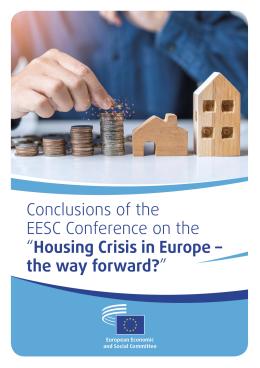
On 20 February 2024 in Brussels, the EESC organised a conference on the Housing Crisis in Europe. This publication sets out the participants' assessment of the current state of affairs and their recommendations on how to tackle the current housing crisis.
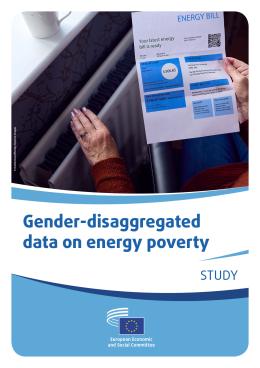
Recent economic shocks from the COVID-19 pandemic and the energy crisis in Europe following Russia’s invasion of Ukraine have brought energy poverty to the forefront of social and political debate. While EU policies increasingly address energy poverty, gender considerations remain overlooked. This study addresses this gap and aims to increase the understanding of the gender-energy poverty nexus, analysing existing literature and EU and national policies.
Already in 2018 the European Commission has proposed a Regulation on a mechanism to resolve legal and administrative obstacles in a cross-border context for the programming period 2021-2027. At the time, the EESC has adopted its opinion on 19 September 2018, and the European Parliament adopted its first-reading position on the proposal in February 2019. However, the Council's working party on structural measures decided to cease work on the proposal in May 2021. In October 2022, to break the impasse and take the lead on this issue, the EP's Committee on Regional Development started drawing up a legislative-initiative report, calling on the Commission to present a new legislative proposal. The EP voted the report at its September 2023 plenary session.
The decline of employment in the European agriculture sector increases the need of EU and non-EU seasonal workers at peaks of planting and harvesting activities. EU citizens’ freedom and right to work across the Union allows the proper functioning of the market economy by providing labour where and when it is needed. Still, after 30 years of the single market, once seasonal workers arrive at their destination, they are subject to fragmented, often localised, employment arrangements and rules.
The Consultative Commission on Industrial Change (known by its French acronym of CCMI, Commission Consultative des Mutations Industrielles), is the heir of the European Coal and Steel Community (CECA in French) and joined the EESC in 2002. Since then, the CCMI’s remit does no longer only cover the traditional coal and steel sectors but has been extended to embrace all sectors of industry in both manufacturing and services.