
European Economic
and Social Committee
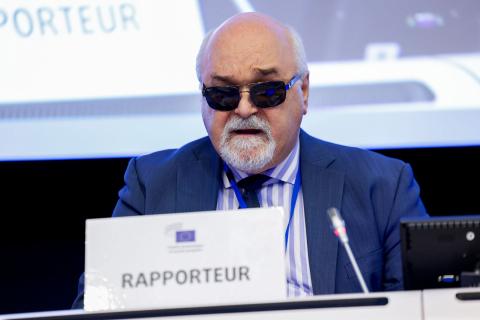
The European Commission says its proposal for the next long-term EU budget will make EU funding simpler, more flexible and better equipped for the future. But for people with disabilities and other vulnerable groups, it raises a fundamental concern: that simplification is becoming a cover for weakening disability rights and removing elements of social protection, writes EESC member Ioannis Vardakastanis.
By Ioannis Vardakastanis
On 16 July 2025, the European Commission proudly launched its proposal for the EU’s next long‑term budget: the Multiannual Financial Framework. It came with bold claims: a record-breaking EUR 2 trillion for 2028–2034, a simplified budget structure, streamlined funding rules, and the promise of keeping the EU competitive and secure in an unstable world.
The promises aren’t quite all that they seem
It didn’t take long for the public to question these claims. The supposed generosity of this 'record-breaking' budget quickly showed itself to be misleading. Eight percent of the entire budget will go towards repaying COVID‑related debt. And because the EUR 2 trillion figure is expressed in current prices after years of high inflation, the real purchasing power of the budget is essentially unchanged from the previous cycle.
The promised simplification has been delivered, but at a cost. Several long‑standing pillars of EU cohesion policy, such as the European Social Fund, the Regional Development Fund and the Common Agricultural Fund, have been merged into one giant fund. Member State allocations will be planned through new National and Regional Partnership Plans. Meanwhile, the legal texts themselves have been stripped back, raising serious concerns for marginalised groups, including people with disabilities.
What does this simplification mean for people with disabilities?
The first casualties of simplification have been the Enabling Conditions. These currently set out clear eligibility criteria for using EU funds, including the obligation to implement the UN Convention on the Rights of Persons with Disabilities (UNCRPD). In the new proposal, Enabling Conditions have been replaced by a lighter set of Horizontal Principles. And while reference to the EU Charter of Fundamental Rights has been retained, reference to the UNCRPD is no longer explicitly included.
This omission is baffling in view of the EU’s own data. Eurostat shows a decade of stagnation in outcomes for people with disabilities in employment, education and poverty reduction. Eurofound research also highlights a worsening trend of institutionalisation, an area where EU funds could be transformative.
We are already facing the problem of EU money flowing into segregating settings, particularly residential institutions, often due to overly flexible interpretation of the rules. The disability movement has long called for clearer, more explicit safeguards to ensure that EU funds promote inclusion and respect rights. Instead, the new simplified text risks opening the door to even looser controls.
What changes for EU spending on social objectives?
Merging the European Social Fund into the Partnership Plans raises further issues. The Commission has been inconsistent in explaining how much money will actually go towards social objectives. While the regulation states that at least 14% of funding should support social actions, it remains unclear from what amount this 14% will be taken. The Commission has struggled to provide a definitive figure.
The scope of what counts as social investment has also widened. The current ESF+ clearly defines eligible measures, but the new rules allow broader interpretation. Social spending may now include infrastructure projects with a social element, such as housing. While valuable, such projects can absorb large amounts of funding. A social budget that is, in real terms, no larger than today’s ESF+ will now be expected to cover costly building projects previously funded by the Regional Development Fund.
There is a real risk that infrastructure could consume almost the entire social envelope. This is because earmarking – i.e. protected minimum shares for specific objectives – has been removed. Under ESF+, at least 25% of social spending must support social inclusion, including for the most marginalised groups. People with disabilities have relied heavily on this guarantee.
The Commission has now removed these protections, giving Member States far more freedom. Countries already committed to disability inclusion will likely continue to invest, but those lagging behind will likely further underinvest. The gap between Member States will widen, undermining the very purpose of EU cohesion policy.
What are we asking for?
The European disability movement is clear about this: simplification cannot come at the expense of our rights. EU policymakers in the Parliament and Council, who now hold the pen, must reverse the Commission’s decision to downgrade disability rights in the legal texts.
EU funding regulations must provide precision and clarity. There must be no ambiguity about ensuring sufficient investment in the inclusion of people with disabilities, and no doubt that this investment must fully respect the rights set out in the UN Convention.
Ioannis Vardakastanis is a member of the EESC's Civil Society Organisations' Group. He is president of the National Confederation of Disabled People of Greece (ESAMEA) and former president of the European Disability Forum (EDF).