Achieving Europe’s climate neutrality goals starts at local level. As cities account for the majority of greenhouse gas emissions and local and regional authorities are responsible for implementing most climate adaptation measures, their role in driving the energy transition is crucial. The conference will explore how empowering cities, regions, businesses and citizens can accelerate decarbonisation while enhancing energy security and local energy autonomy. Through discussions on decentralised renewable energy systems, smart grids, energy storage and citizen engagement, the event will highlight practical pathways towards an affordable and community-driven clean energy transition.
The European Economic and Social Committee (EESC) invites you to attend our public hearing on how using artificial intelligence and digitalisation in tax administration can strengthen legal clarity, cross-border comparability, economic development and tax certainty.
The public hearing will focus on the capacity to reduce fragmentation and compliance burdens, while facilitating compliance and collection across Member States. The hearing will bring together policymakers, stakeholders and experts from across countries and organisations to discuss on digitizing the EU tax system.
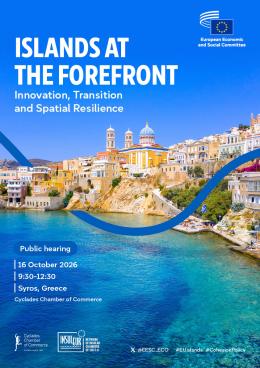
As part of the preparation of the EESC opinion on an EU Strategy for Islands, the European Economic and Social Committee, in cooperation with INSULEUR, will hold a public hearing in Syros, at the heart of the Cyclades. The hearing aims to bring together local and regional authorities, organised civil society, businesses, academia and citizens to exchange views on both the challenges and the untapped opportunities facing Europe's islands.
Talbot Hotel Stillorgan, Conference room: Shelbourne suite
Address: Stillorgan Road, Dublin
Dublin
Ireland
The Workers' Group Extraordinary meeting is taking place in Dublin in the context of the Irish Presidency. The event will bring together EESC members, EU officials, Members from the European Parliament, representatives from Irish Trade Unions and members from academia.
rue Belliard 101, Jacques Delors building, room JDE 63, 9:30-11:00
Brussels
Belgium
EESC, room JDE 63, 9:30-11:00
The policy debate brings together stakeholders to assess how National and Regional and Partnership Plans will work in practice. In a workshop setting connected to the European Economic and Social Committee, participants from civil society, social partners and institutions will exchange perspectives on transparency, inclusiveness and impact. The discussion aims to highlight gaps, share best practices and strengthen the role of organised civil society in shaping and monitoring the implementation of NRPPs in the EU.
From concept to practice for more sustainable food systems in the EU
Location
Brussels
Belgium
On Thursday 8 October, from 16:00 to 17:30 CEST, the NAT Section of the EESC is hosting a debate on the right to food during its monthly Section meeting. The event will focus on presenting a common understanding of the concept of the right to food, as well as opportunities and barriers for more sustainable food systems in the EU.
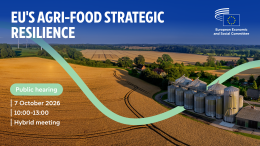
On Wednesday 7 October, from 10:00 - 13:00 CEST, the European Economic and Social Committee will host a public debate about the resilience of the EU's agri-food systems. This debate will focus on how to reduce the vulnerabilities and strategic dependencies of European food systems, increase the EU's readiness in the face of crisis, and learn from existing solutions.
The EU-Central America DAG met on 6 October 2026 in Brussels and online. Members received briefings from the EEAS, DG TRADE and DG INTPA on recent political, economic and social developments in Central America, the implementation of the Association Agreement and EU cooperation priorities. Particular attention was given to labour issues, the role of civil society and preparations for the regional labour conference. During its internal session, the DAG reviewed follow-up to the Joint Declarations adopted in 2025 and 2026, discussed future intersessional activities and webinars, and considered developments related to labour rights and democratic governance in the region.