The EESC is organising this public debat to discuss how civil society partners can use a results-orientation approach in cohesion policy for the next programming period. The principles of multi-level governance and shared management are contradictory or complementary to the results-focused cohesion policy ?
The Commission is proposing amendments to three EU regulations to ensure that EU funds can be quickly mobilised in support of post-disaster recovery.
The amendments concern theRegulations governing the European Regional Development Fund (ERDF) and the Cohesion Fund (CF), and the European Social FundPlus (ESF+), for the 2021-2027 programming period.
These proposals come as a direct response to the floods affecting Central and Eastern European countries and wildfires in Portugal in September 2024 and include injecting liquidity with increased pre- and co-financing under Cohesion Policy.
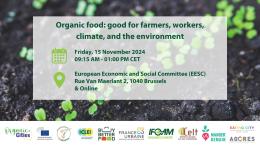
On 15 November the EESC will host a pivotal event focusing on the benefits of organic food and the critical role of public procurement in advancing sustainable practices. This event will bring together representatives from cities, national governments, and institutions to discuss the future of organic farming and its impact on farmers, workers, the climate, and the environment.
This event will explore how circular economy and bioeconomy can drive sustainable agri-food systemsdevelopment across both rural and urban areas in the EU, through the presentation of innovative approaches that support the balanced development of rural and urban communities
Cohesion policy in its current form has had positive impact on the socio-economic development of the EU, individual countries and regions. However, the Polish presidency points out that there is a need to improve the effectiveness of the mechanisms supporting the transformational objectives of cohesion policy. In the discussion of its future, there are ideas aimed at reforming the implementation mechanisms with the approach used in the implementation of the Recovery and Resilience Facility (RRF) implemented since 2021 as a response to the challenges arising from the COVID-19 pandemic and to support the transformation processes of economies.
EESC with this Resolution, calls on the Member States of the European Union and its leaders, the European institutions and the EU citizens, to safeguard and protect the economic, social and territorial cohesion of the EU according to Article 174 of the TFEU.
The fundamental principle of cohesion policy, according to which ‘no one should be left behind’, remains sound and valid. Civil society partners are ready to continue working towards it by means of a solid EU investment policy.
The European Economic and Social Committee (EESC) believes that in the heartlands of Europe lie the seeds of its future prosperity. In an own initiative opinion adopted at its April plenary, it underscores its steadfast commitment to nurturing rural communities and reaffirms its dedication to the long-term vision for the EU's rural areas (LTVRA). The EESC proposes a European charter of rights and responsibilities as a step toward a comprehensive EU rural strategy.
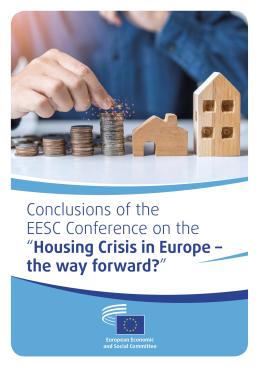
On 20 February 2024 in Brussels, the EESC organised a conference on the Housing Crisis in Europe. This publication sets out the participants' assessment of the current state of affairs and their recommendations on how to tackle the current housing crisis.
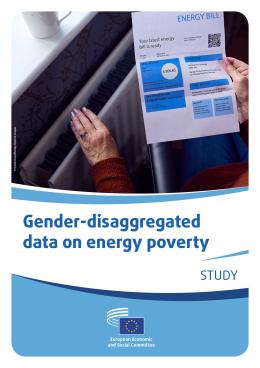
Recent economic shocks from the COVID-19 pandemic and the energy crisis in Europe following Russia’s invasion of Ukraine have brought energy poverty to the forefront of social and political debate. While EU policies increasingly address energy poverty, gender considerations remain overlooked. This study addresses this gap and aims to increase the understanding of the gender-energy poverty nexus, analysing existing literature and EU and national policies.
This public hearing aims to exchange views with civil society representatives from candidate countries and EU's stakeholders on the opportunities and challenges for the EU-agri-food sector with EU enlargement and to identify the contributions of the accession countries to the EU's social, environmental, and economic sustainability.