The EESC underlines that increased equity funding for European companies is key and therefore strongly welcomes the Listing Act proposed by the Commission. Bringing family-owned companies to capital markets would open up untapped potential to attract capital for growth. In this context, a multiple-voting rights regime helps families to retain control, making listing more attractive to them, and streamlining the contents of a prospectus would significantly reduce costs and burden for issuers.
Download format:
Download — Opinjoni tal-KESE: Listing rules for public markets (Listing act)
This hearing will focus on topical questions such as the possible avenues to help MSMEs be well informed and prepared to grasp the opportunities of the transition to climate neutrality, coupling it with the possibilities offered by the digitalisation and hedging the current geopolitical risks. It will also take into consideration the challenges faced by the Belgian companies and the opportunities offered to them if they successfully adjust to the climate neutral and digitalised world.
A debate on challenges and prospects for small and medium-sized enterprises (SMEs) in the EU hosted by the European Economic and Social Committee (EESC) welcomed the measures for SMEs announced in the State of the Union address and discussed EESC proposals to make business transfers easier amid concern over their growing number.
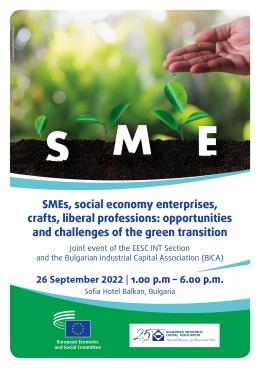
This joint high-level event focused on topical questions such as the challenges faced by Micro, Small, Medium Enterprises (MSMEs) to successfully adjust to the climate neutral and digitalised world. It has also analysed the possible avenues to help MSMEs to be well informed and prepared to grasp the opportunities of the transition to climate neutrality, coupling it with the possibilities offered by the digitalisation and hedging the current geopolitical risks.
The EESC organised a hearing with the title: "Recapitalising EU companies. An innovative way towards sustained and inclusive recovery" in order to present the views of relevant stakeholders, including SMEs, on equity funding.
The Consultative Commission on Industrial Change (known by its French acronym of CCMI, Commission Consultative des Mutations Industrielles), is the heir of the European Coal and Steel Community (CECA in French) and joined the EESC in 2002. Since then, the CCMI’s remit does no longer only cover the traditional coal and steel sectors but has been extended to embrace all sectors of industry in both manufacturing and services.
Between June 2021 and March 2022, the EESC held a series of events on the updated new industrial strategy. Each event was organised by a different section of the EESC and focused on a specific aspect of the strategy, with the aim of hearing the views of civil society organisations on the future of European industry.