
European Economic
and Social Committee

From ’Tourists go home’ graffiti splashed across city walls to protesters firing water pistols at visitors, Barcelona’s backlash against over-tourism has become increasingly visible. Residents say the tourism boom is pushing up rents and property prices, reshaping daily life in the city. The Observatori Metropolità de l’Habitatge de Barcelona (O-HB) – the Barcelona Metropolitan Housing Observatory – provided us with fresh data on short-term rentals and the rise of anti-tourism sentiment.
How have short-term and tourist rentals shaped the housing market in Barcelona in recent years? Can you share some figures about legal tourist apartments and about illegal rentals? Are there clear signs or figures that this trend is affecting rental prices or availability for residents?
To understand the situation of short-term rentals in Barcelona — and in Spain more broadly — the first thing to know is that short-term rentals fall into two categories.
Firstly, there are tourist apartment rentals, which have a duration of less than 31 days. Secondly, there are seasonal rentals. Seasonal rentals are not defined by their duration but by the reason that justifies their non-permanent nature ─ for example, work, medical assistance, or studies. However, these types of rentals typically last less than a year, so we can consider them short-term rentals.
The number of legal tourist apartments grew very rapidly in Barcelona between 2010 and 2014, increasing from 632 to 9 606 apartments. Since 2014, the city council has limited the number of licences, and there are currently 10 327 legal apartments in the city. On the other hand, the number of illegal tourist apartments has been decreasing, mainly due to the significant efforts and resources dedicated by the municipal inspection services. Nevertheless, as of February 2025, there is still a considerable number of illegal tourist apartments available on online platforms, especially on Airbnb, but also on HomeAway and Booking (see fig. 1).
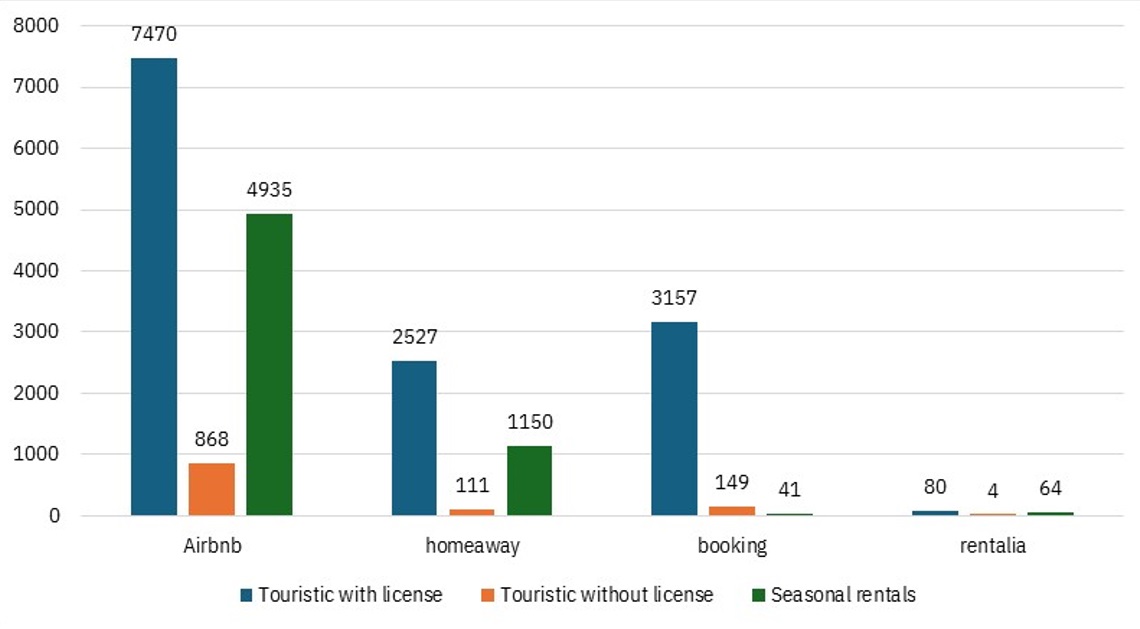
As for the impact of tourist apartments on the price of primary housing, one of the few academically rigorous studies is the one carried out by García-López, Montseny, and Martinez-Mazza. These researchers concluded that between 2012 and 2016, in neighbourhoods with a higher concentration of tourist apartments, these caused a 7% increase in residential rental prices and a 17% increase in the price of property sales transactions.
The latest figures show a decrease in the average rental price in 2024, and for the first time in a decade, a narrowing of the gap between income and rental prices. At the same time there has been a staggering 62% rise in seasonal rentals – how can this be explained?
There are two types of explanations for the rise in seasonal rentals, which we have not yet been able to verify with data. On one hand, some argue that the increase is due to the regularisation of apartments that were already being rented seasonally, but had previously been listed under permanent housing contracts. On the other hand, others argue that the rise in seasonal rentals is the result of a shift from permanent contracts to seasonal contracts, as a way to avoid rent regulation (since seasonal contracts are not subject to the same rent controls as permanent housing contracts), which would constitute a violation of the Urban Leases Act. The Government of Catalonia is currently setting up an inspection service to monitor these practices and, where necessary, sanction misconduct.
Public anger about tourism seems to be tied to housing issues in Barcelona. Based on your research, to what extent are rising rents and short-term rentals feeding into the anti-tourism sentiment we’ve seen lately? Is the growth of short-term rentals affecting neighbourhood life in the city?
The growing backlash against tourism is due to a combination of many factors, among which the increase in tourist apartments is certainly one. In this regard, Barcelona City Council carries out an annual survey on public perceptions of tourism, which confirms the increasing problems relating to co-existence in residential buildings. Thus, 57.8% of Barcelona’s population believed that tourist apartments were a source of disturbances among neighbours in 2023. Specifically, 23.5% considered that there were a lot of disturbances, and another 34.4% reported some disturbances. Notably, the proportion of people perceiving disturbances increased from 49.3% in 2016 to 57.8% in 2023.
The ‘Observatori Metropolità de l’Habitatge de Barcelona’ (O-HB) is a supra-municipal body dedicated to research and analysis with regard to housing. Its purpose is to support the design and evaluation of public policies. It was created in 2017 as an initiative of Barcelona City Council, the Metropolitan Area of Barcelona (AMB), the ‘Diputació de Barcelona’ (Barcelona Provincial Council) and the ‘Generalitat de Catalunya’ (Government of Catalonia), with the support of the Association of Social Housing Managers (GHS). Since 2018, it has been integrated into the structure of the ‘Institut Metròpoli’.