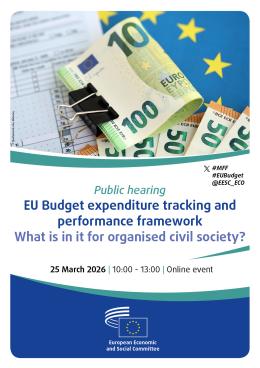
In this overview the European Economic and Social Committee (EESC) shares its opinions on the European Commission’s proposals for the Multiannual Financial Framework (MFF) 2028-2034, bringing together the perspectives of organised civil society on the future direction of the EU budget.
rue Belliard 101, Jacques Delors building, room JDE 63, 9:30-11:00
Brussels
Belgium
EESC, room JDE 63, 9:30-11:00
The policy debate brings together stakeholders to assess how National and Regional and Partnership Plans will work in practice. In a workshop setting connected to the European Economic and Social Committee, participants from civil society, social partners and institutions will exchange perspectives on transparency, inclusiveness and impact. The discussion aims to highlight gaps, share best practices and strengthen the role of organised civil society in shaping and monitoring the implementation of NRPPs in the EU.
Public debate in the ECO Section on the The Multiannual Financial Framework after 2027 - Assessing progress and outstanding challenges. The event will take stock of developments in the negotiations since the Commission presented their proposals for the next Multiannual Financial Framework and discuss outstanding challenges.
The permanent group on Inclusion of the Roma is organising a public hearing on 8 June 2026 on the topic of "United in Diversity: Roma Inclusion and Our Shared European Culture". The hearing will bring together policy-makers and civil society organisations to exchange views on how Roma culture is connected to a shared European identity, as well as on the visibility of Roma contributions in culture, media, and education across the European Union.
The European Economic and Social Committee (EESC) held a high-level debate demonstrating that culture is not a luxury, but a strategic asset for democracy, social cohesion and Europe’s economic resilience. Speakers call for stronger political recognition and sustained investment to turn ambition into action.
Europe is facing a pivotal moment. Social and economic inequalities, rapid technological change, anti-democratic forces and geopolitical instability are straining the foundations of the European project.
With democracy and civic space under mounting pressure, civil society organisations, human rights defenders and free media face growing constraints - from restrictive laws and disinformation campaigns to underfunding and public distrust. Deepening polarisation and eroding trust in institutions further undermine Europe’s democratic model.