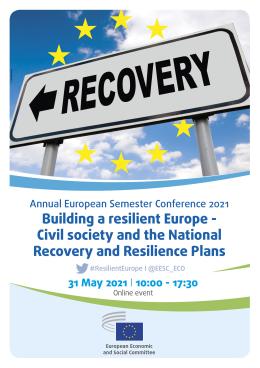
Building a resilient Europe - Civil society and the National Recovery and Resilience Plans
Event type
Conference
Location
Brussels
Belgium
The Recovery and Resilience Facility is moving into its next phase, and the European Semester Group of the EESC is following the process. In this high-level conference we will discuss whether the national recovery and resilience plans will deliver as regards the aim of achieving fair, inclusive, competitive and sustainable growth and cohesion through the new growth strategy – the European Green Deal. Focus will be on the implementation of the national recovery and resilience plans, with particular attention on the implementation of the European Pillar of Social Rights and the just transition towards a green, digital and sustainable European economy. The conclusions of this event will be forwarded to EU institutions and the "EU Recovery Summit" conference in Lisbon on 28 June 2021.
The EESC laments the severity of the money laundering phenomenon in the EU. Current European legislation is largely inadequate in the face of coordination failures and national divergences, and therefore strongly supports the Anti Money Laundering legislative package, in particular the creation and design of the new European Anti-Money Laundering Authority (AMLA) with direct supervisory powers.
The EESC strongly believes in the importance of the next Semester cycle as a key instrument for implementing the Recovery and Resilience Facility.
However, it is still concerned about the lack of clarity in most Member States as regards their National Recovery and Resilience Plan governance systems and the distribution of responsibilities for their implementation.
The EESC would also draw attention to the need to measure progress in implementation, for which good monitoring indicators are needed; in this connection it welcomes the "Recovery and Resilience Scoreboard" initiative.
Moreover, the COVID-19 crisis has highlighted the need for a strong industrial policy to avoid dependence on other economic zones for many products and services.
The EESC wants to see real action in this respect by Member States, in terms of investment in education, infrastructure and industrial policy to raise employment and boost European industry.
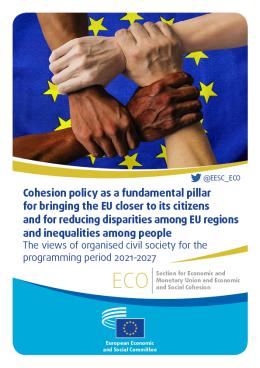
This brochure presents the EESC's opinions relating to the cohesion policy for the post-2020 period. It demonstrates the important role played by organised civil society representatives during this period in exerting influence on decision-makers, which led to the adoption of a number of important policy packages concerning the next programming period. The EESC was the first European institution to contribute to the development of the new programming period (2021-2027).
This brochure presents the EESC's opinions, position papers, resolutions and statements calling for the necessary measures to be taken at EU level, or commenting on those that have already been put forward, in order to tackle the economic effects of the COVID-19 pandemic. We pushed for a reconstruction and recovery plan that lives up to this unprecedented challenge.
The forthcoming Presidency of the Council of the EU (Germany), aims to further discuss and analyze the policy objective 1 under the Common Provisions Regulation for cohesion policy that refers to '' a smarter Europe by promoting innovative and smart economic transformation''. In this context, the Presidency has asked the EESC to provide an opinion on how the structural measures and cohesion policy programmes can help in this process. The Presidency plans to present the key findings of this discussion in a High-level conference that will take place on 29th of September where also the opinion of EESC will be discussed.
Download format:
Download — EESK atzinums: The role of EU structural and cohesion policy in driving forward the transformation of the economy in an innovative and smart manner (Exploratory opinion at the request of the German presidency)