Competitiveness is not an end in itself. It is only a sensible objective if it improves people's well-being in practice. The EESC therefore recommends that an updated definition of competitiveness ("competitiveness 2.0") be used in future, taking into account "the ability of a country to deliver the beyond-GDP goals for its citizens". The EESC urges that future discussions refer not to "competitiveness boards" but to "boards for competitiveness, social cohesion and sustainability". The EESC asks the Commission to present concrete proposals on how the following necessary requirements with regards to these boards can be safeguarded: accountability, legitimacy and transparency; representation of balanced unbiased expertise; non-binding character of proposals of the boards; inclusion of the dual role of wages, both as a cost factor and as the main determinant of domestic demand.
Download — Mišljenje EGSO-a: Establishment of National Competitiveness Boards within the Euro Area
The Commission communication on Steps towards completing EMU can provide a great opportunity to launch a debate at political level and with civil society to draw up conclusive proposals which go further than the current ones. It would be more useful to draw up a proposal for the European Semester as part of a comprehensive agreement on economic governance that goes beyond the status quo, changing macroconditionality and strengthening the Interparliamentary Conference. Democratic legitimacy is not tackled seriously by any of the Commission's operational proposals. The tripartite social dialogue could contribute to this matter. On the basis of its own roadmap, the EESC is committed to putting forward, possibly with the Commission, a plan on stage two (Completing EMU 2017-2025) to discuss these issues in the Member States, beginning with the euro area countries.
Download — Mišljenje EGSO-a: Steps towards Completing Economic and Monetary Union
Comparable data on volunteering in the individual EU Member States has never been available. Such activities, however, represent real economic value and this data could provide a very useful tool for facilitating implementation of many social and economic policies. Therefore the Committee calls on the European Commission to work on a standardised methodology for research into volunteer work and to ensure its adoption by the Member States via an appropriate EU Regulation. In so doing, use should be made of the ILO Manual on the Measurement of Volunteer Work. The Commission should also introduce binding legal measures to enable the non-profit sector to co-finance public grants with the economic value of volunteer work.
Download — Statistical tools for measuring volunteering
Lessons learned and a new Inflation Governance Framework
Event type
Conference
Location
room VMA 22, Van Maerlant 2
Brussels
Belgium
On Wednesday, 3 September 2025, from 14:00 – 17:30 (CET), the European Economic and Social Committee (EESC) will host an event organised by the Foundation for European Progressive Studies, in cooperation with Fondazione Pietro Nenni and tasc, discussing lessons learned from the recent inflation episode and the new inflation governance framework that needs to be developed to prevent or mitigate the supply side inflation shocks in the future.
GDP is the best-known measure of macro-economic activity. While it is used both by policy-makers around the world and in public debates, it was not designed to be a comprehensive measure of prosperity and well-being. Thus, other indicators are needed to assess and address the global challenges of the 21st century such as climate change, poverty, resource depletion and to promote health and a higher quality of life. Beyond GDP indicators should become instruments to not only monitor and measure, but also to inform policy development, improve communication and encourage target setting. Against this background, the Section for Economic and Monetary Union and Economic and Social Cohesion (ECO) of the European Economic and Social Committee (EESC) is currently working on an own-initiative opinion on 'Beyond GDP measures for a successful recovery and a sustainable and resilient EU economy'.
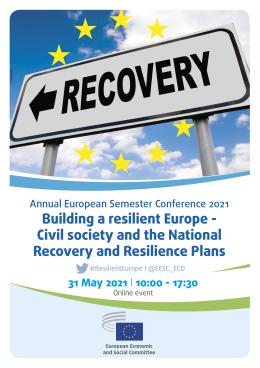
Building a resilient Europe - Civil society and the National Recovery and Resilience Plans
Event type
Conference
Location
Brussels
Belgium
The Recovery and Resilience Facility is moving into its next phase, and the European Semester Group of the EESC is following the process. In this high-level conference we will discuss whether the national recovery and resilience plans will deliver as regards the aim of achieving fair, inclusive, competitive and sustainable growth and cohesion through the new growth strategy – the European Green Deal. Focus will be on the implementation of the national recovery and resilience plans, with particular attention on the implementation of the European Pillar of Social Rights and the just transition towards a green, digital and sustainable European economy. The conclusions of this event will be forwarded to EU institutions and the "EU Recovery Summit" conference in Lisbon on 28 June 2021.