
European Economic
and Social Committee
Nature credits under scrutiny: Europe’s test of credibility on biodiversity
Europe cannot afford to treat biodiversity as a secondary concern. In the recent opinion adopted by the European Economic and Social Committee (EESC) in its February plenary, is stressed that the Kunming‑Montreal Global Biodiversity Framework set ambitious global targets, but ambition alone will not restore degraded ecosystems or protect collapsing species. Delivery, not declarations, will determine whether 2030 marks a turning point or another missed deadline.
At the centre of the debate is the emerging concept of “nature credits”, market-based tools intended to channel investment into ecosystem restoration.
The stakes could hardly be higher. The EU has committed to halt and reverse nature loss by 2030. Yet the funding gap for biodiversity protection remains vast.
The message to the European Commission is clear: public money must come first. Stable, sufficient and timely funding — including from the EU budget — is non-negotiable. Environmentally harmful subsidies, notably for fossil fuels, must be phased out. Private finance can help, but not as a substitute for public responsibility.
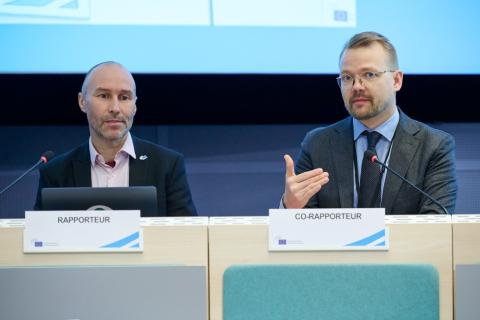
As Arnaud SCHWARTZ, the opinion’s rapporteur, states: “Public funding must lead, nature credits cannot replace stronger ambition.” Nature credits could help close the funding gap. But only under strict conditions.
The opinion insists on high-integrity principles. Any framework must follow the mitigation hierarchy — avoid, minimise, restore, compensate — and be rooted firmly in science. Projects should be assessed through holistic, outcome-based methodologies. Enforcement of environmental law, often the EU’s Achilles heel, must underpin the system.
Governance is equally critical. A nature credits market must be science-based, transparent and participatory. Those most affected — rural communities, indigenous peoples, women and young people — must have a real say. Data ownership and management must be fair.
“If nature credits are to work,” adds co-rapporteur Teppo SÄKKINEN, “they must be inclusive, science-based and fair.”
Above all, there is a warning that resonates strongly: nature must not be commodified.
Land grabbing and speculation must be prevented at all costs. Nature credits should prioritise ecological integrity over short-term profit. Benefits must be distributed fairly, helping to reduce rather than deepen inequalities.
The committee also urges caution over rushing into heavy legislation. Nature credits should remain voluntary, tightly regulated, but not imposed in ways that undermine ambitious national initiatives. Alignment with other EU policies, from agriculture to the circular economy, must be clarified to avoid unnecessary administrative burdens, particularly for small-scale practitioners.
There is also a global dimension. Exporting a European-designed system beyond the EU could prove complex. Governance models that work in Brussels may not translate neatly into different social, cultural and ecological contexts abroad. Generating nature-positive impacts in global value chains will require responsibility and sensitivity.
The time to act is now. Europe has both the responsibility and the opportunity to build a credible, fair and science-based framework — one capable of protecting biodiversity while securing a sustainable future for all.
Background: the EU Youth Test
This opinion was among the first to be examined under the European Economic and Social Committee’s “EU Youth Test”, a mechanism designed to integrate young people directly into EU policymaking processes.
To represent a coalition of youth organisations, the European Youth Parliament for Water participated in the drafting process. Rather than being consulted at the margins, youth representatives contributed during the preparation of the opinion itself, bringing forward concerns about environmental integrity, social fairness and long-term generational impacts.
The initiative reflects a growing recognition within EU institutions that biodiversity policy is not only technical and financial, but generational. (ks)