Do civil society organisations in France, Germany, Italy, Greece, Hungary, and Poland share a common understanding of the values of democracy, the rule of law, and solidarity? This research shows that CSOs tend to converge in their definitions of these values, even if they display more diverse interpretations of solidarity than of democracy and the rule of law. It also reveals that CSOs recognise the crucial role that the civil sector plays in promoting these values.
The study provides a review of the issues facing non-state actors in accessing climate finance in the EU. Non-state actors, including local and regional authorities, businesses (including SMEs), trade unions, civil society and NGOs, face specific challenges when accessing climate finance. These can include the absence of enabling regulatory and policy frameworks, information barriers, internal capacity constraints and a group of challenges related to restricted availability of climate finance.
The EESC adopted its contribution to the 2021 European Commission work programme on 17 July 2020, with a very broad consensus. The document links the priorities already identified in the EESC resolution on post-Covid 19 recovery and reconstruction with the six Headline ambitions defined by the EC President von der Leyen.
The EESC adopted its contribution to the 2021 European Commission work programme on 17 July 2020, with a very broad consensus. The document links the priorities already identified in the EESC resolution on post-Covid 19 recovery and reconstruction with the six Headline ambitions defined by the EC President von der Leyen
The EESC suggests taking the opportunity of the Covid-19 crisis to build a new societal model, making our economies greener, fairer and more resilient to future shocks.
The EESC suggests taking the opportunity of the Covid-19 crisis to build a new societal model, making our economies greener, fairer and more resilient to future shocks.
The German Presidency should pave the way to a European recovery that invests in a care strategy
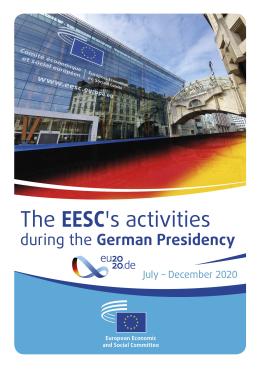
In the second half of 2020, Germany will assume the rotating Presidency of the Council of the European Union. The German Presidency comes at a time when the European Union is facing unprecedented challenges. While its programme and organisational possibilities are heavily impacted by the COVID-19 crisis, there is widespread demand and political energy to depart from business-as-usual modus operandi and embrace change.
The report highlights trends in Europe based on seven country visits that took place in 2018-2019 in Romania, Poland, Hungary, Austria, France, Bulgaria and Italy. It updates the interim report published in November 2019, integrates the main conclusions of the November 2019 conference on ‘Fundamental rights and the rule of law – Trends in the EU from a civil society perspective’, and annexes country reports and observations by the national authorities.
The corona crisis is a huge human and societal tragedy for Europeans and for people throughout the world. Tackling its diverse impacts requires a series of measures, from coping with the emergency stage and proceeding via recovery and rebuilding towards long-term success and stability. Businesses that manage to recover well and succeed are key to the recovery of the EU economy as a whole.