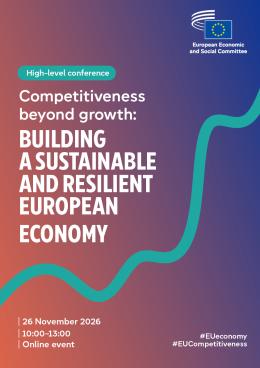
As Europe seeks to strengthen its competitiveness in an increasingly fragmented global economy, the challenge is not only to boost productivity and innovation, but also to preserve the foundations of its social market economy. This high-level conference will examine how the EU can mobilise savings and investment, maintain sustainable public finances, and deepen Economic and Monetary Union to support long-term growth, resilience and convergence.
Europe’s housing crisis is one of the EU’s most urgent social and economic challenges. By bringing together actors from across the housing and homelessness ecosystem together with EU institutions, Member States, organised civil society, local and regional authorities the conference aims to identify effective measures and practical solutions to increase the supply of affordable and sustainable housing, improve access to housing, and reinforce a coherent European response that fully respects Member States’ competences.
Launch of the European Employment and Social Outlook (EESO) 2026
Location
European Economic and Social Committee (EESC), Rue Belliard 99/101
Brussels
Belgium
Jointly organised by the European Commission and the European Economic and Social Committee (EESC), this conference will be an opportunity to discuss key insights from the European Employment and Social Outlook (EESO) 2026 – the flagship report from the European Commission’s Directorate-General for Employment, Social Affairs and Inclusion’s (DG EMPL).
The conference will feature high-level speakers from EU institutions and research institutes. Executive Vice-President of the European Commission, Ms. Roxana Mînzatu, and the President of the EESC's Section for Employment, Social Affairs and Citizenship, Ms. Cinzia Del Rio, will open the event.
As in previous years, the European Economic and Social Committee (EESC) will actively participate in COP17 to the UN Convention on Biological Diversity (CBD), which will take place from 19 to 30 October 2026 in Yerevan, Armenia.
The permanent group on Inclusion of the Roma is organising a public hearing on 29 October 2026 on the topic of "Inclusive Roma Education, Upskilling and Pathways to Quality Jobs". The hearing will look at:
The role of the EU Union for Skills in Roma integration
Good practices on fighting segregation in education
Good practices on Roma inclusion in the labour market through VET
Roma women's education and integration in the labour market
Teatro Thalia, Estrada das Laranjeiras 205, Lisboa, Portugal
Lisbon
Portugal
The annual Euro-Mediterranean Summit of Economic and Social Councils and Similar Institutions provides civil society organisations (CSOs) from the UfM Member States with a platform to debate common challenges and opportunities and to exchange best practices.