
European Economic
and Social Committee
Citizens’ Energy Package – EESC calls for real guarantees to ensure a citizen-driven energy transition
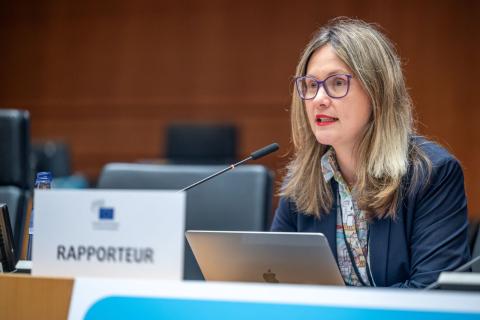
In an opinion adopted at the September plenary, the European Economic and Social Committee (EESC) says that the Commission has not yet managed to really put people at the heart of the EU’s energy system, and calls for the new initiative to provide the right guarantees in this direction.
The EESC throws its support behind the European Commission’s initiative to draw up a Citizens’ Energy Package, and stresses that it must go beyond being just another checklist. It must become the foundation of a true social pact for a citizen-driven energy transition.
In the opinion Citizens’ Energy Package: citizens’ engagement, energy communities and prosumerism drafted by Corina Murafa Benga and adopted at the EESC’s September plenary session, the Committee sets out its vision to ensure that the energy transition turns into reality. It says that the new initiative should give clarity to key concepts around citizen energy and shift the paradigm from people as energy consumers to people as co-creators of their energy future.
The EESC has, for many years, expressed concerns that the EU is not delivering properly on its intention to place Europeans at the heart of the energy system and hopes that the new package can provide clear guidance to Member States on key areas such as energy communities and prosumers, citizen participation and energy poverty.
Energy communities play a strategic role
To this end, the Committee puts forward some concrete proposals:
- The new initiative should clearly acknowledge and promote the strategic role of citizen energy communities in energy policy. At the same time, it must clarify key concepts related to community energy, such as membership, autonomy and effective control, which are now understood very differently by Member States.
- The package should contain a toolkit of regulatory sandboxes that Member States must implement without delay to make energy communities and the right to energy sharing a functional reality across the EU. It should offer clear guidance on how to establish and run energy communities, in particular tax and tariff deductions, facilities and technical support offered by Distribution System Operators (DSOs), which Member States cannot bypass.
- Through the next Multiannual Financial Framework, the Commission must create dedicated funding streams for energy communities. The European Investment Bank should develop an energy community facility for local and regional energy communities, similar to the existing SME facility, and other existing good practices on financing energy communities should be scaled up. Funding should also prioritise and be subject to minimal standards being met in the areas of youth engagement, fostering energy literacy and developing green skills.
Citizens must have energy rights
The Citizens’ Energy Package should also take stronger action to tackle energy poverty in the EU and introduce a unified definition and data-driven identification of affected households starting at local level. Households should be the reference point for energy poverty milestones, with macroeconomic indicators used only additionally.
‘Current EU energy discourse frequently positions individuals as “consumers”, implicitly reinforcing market-centric models. We need a shift towards viewing people as “citizens” – members of a political community with energy rights,’ said Ms Murafa Benga. ‘There can be no citizenship without energy, and the EU must uphold the full implementation of European citizenship.’
In order to empower citizens and establish the prerequisites to mitigate energy poverty, the EESC urges the EU to urgently adopt a number of specific measures such as:
1) immediately impose an EU-wide ban on the disconnection of households;
2) move away from the merit order system, which links electricity prices to gas prices;
3) adjust the policy language by referring to ‘citizens’, instead of ‘consumers’, in relation to energy;
4) link any public funding scheme for energy projects to the participation of local communities as shareholders in energy projects and other forms of benefit-sharing;
5) set up a European energy ombudsperson, with local branches in each Member State.
Work organisation
Recommended for you
Rolul activ al societății civile organizate este esențial pentru o UE rezilientă
News
CESE a organizat, în sesiune plenară, o dezbatere privind importanța tot mai mare a societății civile organizate și a orașelor în asigurarea capacității Europei de a face față șocurilor asimetrice și…
Crearea în comun a serviciilor publice în sectorul sănătății va contribui la o democrație mai participativă în UE
News
Acest eveniment, organizat de Comitetul Economic și Social European (CESE) și de Universitatea din Debrecen, a evidențiat importanța crucială a creării în comun a serviciilor de interes general în…
Pentru a combate schimbările climatice, UE are nevoie de mai multe investiții publice în infrastructura energetică
News
Într-un aviz adoptat în sesiunea plenară din septembrie, Comitetul Economic și Social European (CESE) consideră că, pentru a realiza tranziția energetică și obiectivele climatice, sunt necesare…
Energie – CESE avertizează cu privire la crearea de noi dependențe
News
Într-un aviz adoptat în sesiunea sa plenară din septembrie Comitetul Economic și Social European (CESE) adoptă o poziție fermă în domeniul energiei: propunerea Comisiei reprezintă un pas în direcția…
Tranziția digitală trebuie să fie echitabilă: drepturile omului și controlul uman asupra mașinii trebuie să rămână valori fundamentale
News
Comitetul Economic și Social European (CESE) subliniază oportunitățile oferite de revoluția digitală, dar avertizează și cu privire la riscuri: implementate prea rapid, soluțiile digitale pot duce la…