
European Economic
and Social Committee
Speech by President Séamus Boland, EESC plenary debate with Raffaele Fitto, European Commission Executive Vice-President for Cohesion and Reforms
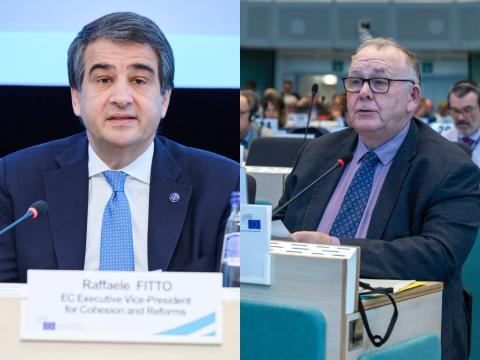
EESC plenary debate on mid-term review of the cohesion policy
Dear Executive Vice-President,
Thank you for joining us today, you are very welcome;
I would like to begin by stating my firm support for a mid-term review of cohesion policy for the period 2021-27;
This discussion is timely, as later this afternoon we will be discussing how the EU should manage the ongoing global geo-political challenges;
Of course, these have resulted in very different economic, political and environmental landscapes, to which the EU will have to adapt, both internally and externally;
Consequently, a mid-term review of the EU Cohesion policy, to complement the revision of the MFF as a whole, is not only welcome, but necessary.
I would like to concentrate my comments on two points, both of which relate to the ESF+;
Clearly, it is necessary to invest in developing skills in strategic sectors such as defence, digitalisation, decarbonisation and new technologies;
However, this must not come at the expense of social inclusion, poverty alleviation and the promotion of qualitative employment;
Consequently, the amended Regulation on the ESF+ must ensure that vulnerable groups, including low-skilled workers, women, as well as disadvantaged groups, continue to benefit from this support.
Secondly, it is imperative that any reflections and decisions on the reallocation of ESF+ resources directly involve civil society organisations;
Civil and social dialogue have a key role to play in shaping the current and future Regulation;
This is particularly the case, in relation to the Just Transition Fund, where we need bottom-up processes;
Civil society organisations are key to delivering the just transition, through their interactions with local government and by their capacity to bring the topic out of the policy arena and into communities;
At the same time, local government has an essential responsibility to support the most vulnerable and those who are less able to adapt to change;
Respect, partnership and honest communication with communities on possible future options, must underlie this joint approach, which should aim to reduce, share and manage the risks of the transition in a just and fair way;
Thank you for your attention.
Work organisation
Downloads
-
Speech by President Séamus Boland