
European Economic
and Social Committee
Macroeconomic implications of the conflict in Iran
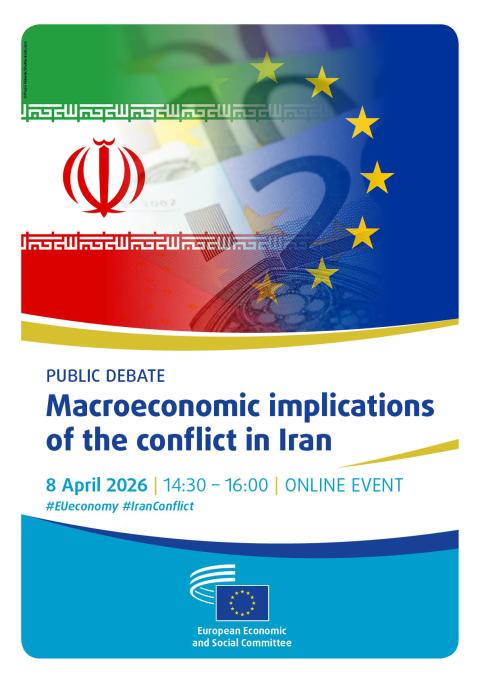
Rising tensions and the renewed conflict in Iran adds new volatility to an already fragile global economic environment. Against a backdrop of geopolitical fragmentation, energy market uncertainty and slowing growth, understanding the macroeconomic implications of this conflict for Europe has become increasingly urgent. The Section for Economic and Monetary Union and Economic and Social Cohesion (ECO) of the European Economic and Social Committee (EESC) will organise a public debate at its upcoming meeting on 8 April 2026, from 14:30-16:00 to examine the broader macroeconomic consequences of the conflict in Iran for the European economy.
The discussion will explore how renewed geopolitical instability may affect the EU’s growth prospects, economic resilience, and Europe's external relations. The debate will also consider the potential implications for the EU’s strategic priorities and how the conflict could reshape Europe’s policy agenda, including key objectives such as the green transition and energy security. The discussion will also examine how shifting geopolitical and economic realities may influence the EU’s priorities and budgetary choices, including the ongoing negotiations on the next Multiannual Financial Framework and the Union’s capacity to address emerging challenges while maintaining its long-term ambitions.
Speakers:
- Andrew Kenningham, Chief Europe Economist, Capital Economics
- Stefano Palmieri, President of the External Relations section (REX), EESC
The event will be webstreamed and open to all interested stakeholders. No registration is needed and participation is free of charge.
Follow the event on X : #EUeconomy #IranConflict I @EESC_ECO
Ask your questions to the panelists via Slido with the event code: #EUeconomy