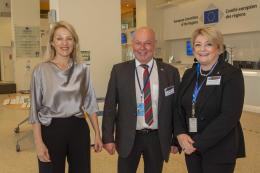
Academia, local civil society organisations, representatives of regional and national authorities and members of the European Economic and Social Committee met at a conference in Dolni Vítkovice, a former industrial area for coal mining and steel production in Ostrava, on 11 October 2022. The conference on Reinventing the Moravian-Silesian Region in search of a socially just transition was organised by the EESC's Civil Society Organisations' Group as part of the Czech Presidency of the Council of the EU.
An interview with Tatjana BABRAUSKIENĖ, Head of International Relations at the Lithuanian Education and Science Trade Union. Currently a member of the NAT, SOC and REX sections, she's very active in education and its link to sustainable development.
The European Economic and Social Committee (EESC) calls on the European Commission to publish an overdue report to consider extending the EU's sustainability taxonomy's scope to social objectives.
The Civil Society Organisations' Group of the European Economic and Social Committee in partnership with Irish Rural Link, the national network representing the interest of rural communities, are holding a joint conference on 'Just Transition' next Thursday, 9 June in Tullamore, Co. Offaly.
On 10 May, the vice-president of the European Parliament Evelyn Regner took part in the European Day of the Liberal Professions 2022, which was hosted by the Liberal Professions Category of the EESC. She spoke during the opening session of the annual conference, which focused on the topic of Liberal Professions: Lessons Learned and Challenges ahead. Various civil society and other institutional representatives participated in the event.
At this critical time for trade and sustainable development (TSD), the European Economic and Social Committee (EESC) held the first European Civil Society Forum on TSD. This was a platform bringing together civil society, academia, EU and international institutions to discuss innovative ideas and concrete recommendations on the future of the EU’s trade policy. A series of breakout sessions covered TSD topics from substantive rights to monitoring, enforcement and much more, inviting participants to voice their views as part of the ongoing review of the 15-point action plan on TSD and recent developments in EU partner countries.
An interview with Nicoletta MERLO, one of the youngest members of the EESC. She is National Head of Youth Policies for CISL, one of the largest Italian trade union confederations, and represents her confederation on the Italian National Youth Council. In 2017 she started a European experience in the European Trade Union Confederation (ETUC), which led her to be elected, in 2019, as a member of the Bureau of the ETUC Youth Committee. Since October 2020, she has been a member of the European Economic and Social Committee and actively participates in the SOC and NAT sections and in the Equality Group, seeking to be spokesperson for the demands and needs of young people and promoting the inclusion of a generational perspective in the Committee's discussions and multiple activities.
Civil society organisations from across Europe called at a conference in Paris for just, fair and inclusive climate and energy transitions that involve citizens, civil society organisations and in particular young people. They consider dialogue, cooperation and coordination at all levels a prerequisite for ...
An interview with Florian MARIN, member of the NAT section of the European Economic and Social Committee (EESC) from the workers' group (GR-II) since 2020. He represents the Federation of Free Trade Union in Romania, of which he's the president. His work focuses, among others, on topics such as rural and sustainable development, sustainable food systems, circular economy and deforestation.