
European Economic
and Social Committee
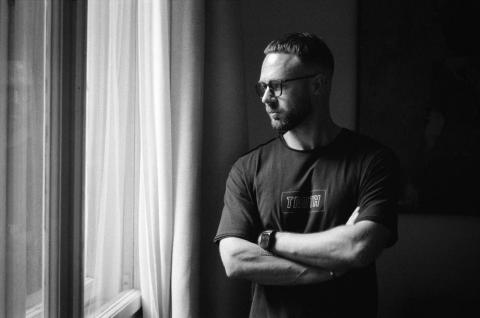
By Andrey Gnyot
On 18 June, the European Economic and Social Committee (EESC) is holding a plenary debate with Sviatlana Tsikhanouskaya, leader of the Belarusian democratic forces. The debate will also welcome Belarusian filmmaker, activist and journalist Andrey Gnyot, who has lived in exile since 2023 following his arrest in Serbia, where he spent a year in extradition detention. We bring you Mr Gnyot’s personal testimony about the climate of fear and repression in Belarus and his ongoing struggle to obtain international protection in the EU.
‘We talk on the phone, for example on WhatsApp or Viber, but we never mention him by name. We speak in vague terms. My mother says, “That’s enough, child, later, later, don’t.” Everyone speaks like that.
Even when you leave the country, when you talk about him (meaning Lukashenko – author’s note) or about what’s going on, you whisper. Subconsciously, you lower your tone – God forbid someone should hear you.’
Maria (I was forced to change her name for safety reasons) spoke to me in a quiet voice. That’s how everyone who stayed in Belarus speaks nowadays. It is the only way to survive, a reflex that has become automatic. It is fuelled by a total, paralysing fear. Maria was arrested for the second time in her life in December 2024, right at the border, when she was returning home to Belarus from the EU. She simply wanted to see me. We met only once, in a typical loud German beer hall, so that we could disappear into the drunk, cheerful crowd, among beer and pork knuckles. That was enough for KGB officers to remove Maria from the bus at the border and accuse her of extremism. On her phone, they discovered a subscription to an Instagram channel labelled ‘extremist’ by the regime – a subscription that appeared there from who knows where. Maria was sent behind bars. She was very lucky – she spent only one day in a cold cell without food, water or bedding. A judge from a small provincial town did not want to spoil his Christmas and New Year dealing with such a dubious case and released her before the 15-day term had expired. A deep sense of guilt settled in me, although I know that it is Lukashenko and his regime who are to blame.
‘I clearly remember a person, a girl, when I was taken at the border. They also took her phone – she was led away for interrogation, and we sat in the back seat with her mother, talking. And when they didn’t return my documents or my phone, when I realised that they were going to take me, I asked... I said, please, you know, they probably won’t let me go. I said, could you give me your phone, so I can call my mum? And she said: “I don't need any trouble.” And that was it. That is, a person who had also been through the same interrogations – that was her reaction.
Now it’s simply our mad ability to survive under the most horrific conditions, just like in the past we survived and endured the Nazis on our territory. That is exactly how we live now, as if he has occupied our country and we just need to lie low and hide, to pretend that we do not exist. To go out and protest... We have more prisons than theatres. It will simply be one more place in a cell – occupied by you.’
I was in prison, and I know: there are no protests in prison. A protest in prison is a riot. A riot will be suppressed, with blood and victims; no one and nothing will get beyond the prison fence. The inmates will be returned to their places, the rioters will be punished in the harshest way. Another fence will appear in the prison, more guards will be added, and next time they will shoot to kill right away. The prison governor will never shut down their own prison or release the innocent. That can only be done by a third force, from beyond the prison fence. Belarus in 2025 is an occupied territory, a prison-concentration camp with external governance and external funding. Can prisoners protest openly there?
‘You know, when we went out to protest, we could tell by the eyes who was one of us, right? And that still exists. That is, you understand who you can talk to and who you can’t. But we haven’t surrendered. We have gone underground. We simply do not know what to do. We are just surviving now. We are just breathing. As if the body has temporarily shut down its vital functions.
But it is very important for us to know what’s happening over there (in Europe – author’s note). We follow, we watch. A voice from the “mainland” is very important to us. So that we are not forgotten. Because here we are cut off from the whole world. We feel as if we live on another planet. We try, we scream with a voiceless cry. So that we are heard, so that we are helped. Because the regime no longer considers us human. We feel that inaction will come back as a great misfortune for everyone. And not only for us.’
I met Maria in Berlin after a year spent under arrest in Serbia. We hadn’t seen each other in 15 years, and we might never have met again if I had been extradited. I lost my health, my family, my successful career, but not hope – I stayed alive, and that means I can continue to fight for the freedom of my country. That was the main feeling I had when I found myself free on 31 October 2024.
I admit, my struggle has not stopped for a single day. ‘The status of an asylum seeker (and the “Geneva passport”) would constitute a completely different legal track to the one including the Section 22.2 visa and it is thus legally and structurally not possible to combine them,’ stated the official letter from the German Foreign Ministry. When I received this e-mail on 17 January 2025, it was like a cold shower. Three days later, I applied for international protection in Warsaw, and a few months later I received a notification that the Polish authorities had made a preliminary decision, ‘which may not meet my expectations’ (quote). Lawyers warned me with concern that if I were deported to Germany under the Dublin Regulation – and that is exactly what was discussed in the letter from the authorities – it was highly likely I would be placed in a refugee camp for up to two years. Another official notification, received by mail at the end of May 2025, stated that my case would be under review for up to 15 months.
On 4 March 2025, Belarusian emigrant Stanislav Brykin died by suicide in the Pabradė refugee camp in Lithuania after being deported from Germany under the Dublin Regulation, according to an article published by NGO Human Rights Without Frontiers. Such news keeps me awake at night, although that may also be a result of my acquired traumas – clinical depression and PTSD. I cannot get rid of them; neither the circumstances nor the limitations of ‘refugee’ medical insurance allow it. I could solve this problem quickly and by myself, but since October 2023 I have been deprived of a source of income. Even now, the law prohibits me from working. In Warsaw, I have no family, no loved ones, no friends. A modest one-room apartment on the outskirts of Minsk in occupied Belarus would barely cover my debts, but it is subject to a ban on sales anyway; all of us Belarusians are hostages of the regime.
Yesterday I received my allowance (about EUR 170), which is paid once a month to migrants like me. This morning, I paid almost EUR 100 in fees at the Belgian embassy.
I found myself free on 31 October 2024. Since then, every day I try to understand what that means.