The 8th EU-Korea Civil Society Forum (CSF) took place on 13 September 2022 in Seoul. During the meeting, the DAGs exchanged views on the EU and the Korea DAGs’ experiences since the first meeting in 2012. Participants also discussed ILO fundamental conventions, as well as Occupational Safety and Health in the presence of a representative from the ILO. Climate initiatives in the EU and Korea with special focus on carbon neutrality and green growth, CBAM from an EU business perspective and the Korean Carbon Neutrality Action Plan were other items on the agenda.
The CSF was completed on 14 September with a workshop on the topic of "Platform work in the EU and Korea" and a presentation on "Corporate Sustainability Due Diligence".
The new 'EU-Ukraine Solidarity Lanes' aim to facilitate the shipment of agricultural products from Ukraine, Ukraine's access to international markets and global supply chains, thereby ensuring that much-needed cereals reach the world market. In the longer term, they should also boost our bilateral trade in goods. In the framework of its work on the EESC opinion on the European Commission action plan for EU-Ukraine Solidarity Lanes to facilitate Ukraine´s agricultural export and bilateral trade with the EU, the TEN Section will bring together prominent guests from the civil society of the EU and Ukraine, to learn first-hand about the situation on the ground and the difficulties that stand in the way and thus offer a valuable contribution to the Commission's efforts.
The rapid progress of digitalisation is leading to financial innovation including the potential introduction of digital central bank currencies. In the EU, the European Central Bank (ECB) and the European Commission are currently working on plans for the introduction of an electronic form of money issued by the Eurosystem (the ECB and national central banks), a digital euro, which would be accessible to all citizens and firms as a complement to cash. Against this background, the Section for Economic and Monetary Union and Economic and Social Cohesion (ECO section) of the European Economic and Social Committee (EESC) is currently working on an own-initiative opinion on the prospects of such a digital euro. This opinion aims to assess state of play in preparation for a digital euro, the prospects of its introduction and provide timely input from the civil society perspective to the Commission and the ECB to the ongoing discussion.
At this 4th meeting of the EU DAG set up under the TCA, the discussion focused on practical aspects as well as the preparations for the 1st DAG-to-DAG meeting (joint meeting of the EU and UK DAGs) and the 1st Civil Society Forum, that took place on October 3rd and 4th respectively.
The 12th meeting of the EU Domestic Advisory Group under the EU-Ukraine DCFTA took place via a videoconference on 6 September 2022. Please click on the programme tab to consult the topics on the agenda.
EESC, Room VMA 3 and online | 14:30 - 16:00 | Rue Belliard 99, 1040
Brussels
Belgium
The EESC´s Consultative Commission on Industrial Change (CCMI) is organising a hearing (web streamed) on the Defence Investment Gaps Analysis and the way forward, with the participation of the European Commission and civil society stakeholders.
In order to prepare its own initiative opinion on "Ensuring strong European solidarity for rare disease patients", the EESC is organising a public hearing on 1st September 2022.
The aim of the event is to gather input from policy makers, civil society organisations and social partners, which will feed into the EESC's opinion.
The first and inaugural meeting of the EU-Armenia Civil Society Platform (CSP) was held on 1st September 2022 in Yerevan. The CSP complements the political bodies existing within the framework of the EU-Armenia Comprehensive and Enhanced Partnership Agreement, and it allows civil society organisations from both sides to monitor the implementation process and prepare recommendations to the EU-Armenia Partnership Council and other relevant bodies both in Armenia as well as in the EU.
The CSP is made up of members from both Parties, representing the EESC and large European civil society networks, on the one side, and civil society organisations from Armenia, on the other side.
During the meeting, a debate focused on assessing the state of play of the implementation of the EU-Armenia Comprehensive and Enhanced Partnership Agreement and the members of the CSP discussed working methods and future activities of the Platform.
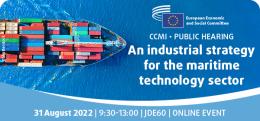
EESC, Room JDE 60 and online | 9:30 - 13:00 | Rue Belliard 99, 1040
Brussels
Belgium
The EESC´s Consultative Commission on Industrial Change (CCMI) is organising a hearing (web streamed) on the maritime industrial strategy, with the participation of the European Commission and civil society stakeholders.