Download — Avizul CESE: Financial aid for Member States and countries still negotiating the terms of their accession to the EU which are seriously affected by a major public health emergency
This additional opinion complements and updates the proposals made in the yearly EESC AGS opinion. The EESC welcomes country-specific recommendations focus on investment and underlines that special attention must be paid to productive investments and investment in social infrastructure to prioritise sustainable growth. Next year's cycle should contain more CSRs to combat the existential threat of climate change. Investment would also be needed to enable the implementation of the social pillar to prevent an increase of social, economic, and environmental inequality. Taxation should favour this type of investment.
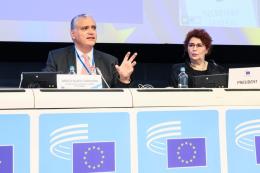
At the July plenary session of the European Economic and Social Committee (EESC), its president Christa Schweng and the newly elected president of the European Committee of the Regions (CoR) Vasco Alves Cordeiro discussed renewed prospects for joint action and cooperation between the two committees.
"Cohesion policy 2028–2034: A new fund, a new framework, a new role for civil society?" brings together EU institutions, social partners and civil society representatives to reflect on the future of cohesion policy in the next Multiannual Financial Framework. The hearing explores proposals for reforming cohesion funding and governance, assesses the implications of the new framework through the National and Regional Partnership Plans and examines how civil society organisations can play a stronger role in the design, implementation and monitoring of cohesion policy. The discussion aims to identify how cohesion policy can continue to deliver territorial, social and economic cohesion while responding to new challenges and transitions facing the European Union.