
European Economic
and Social Committee
Dealing with sustainable and balanced rural and urban development the key to EU citizens' well-being, says EESC
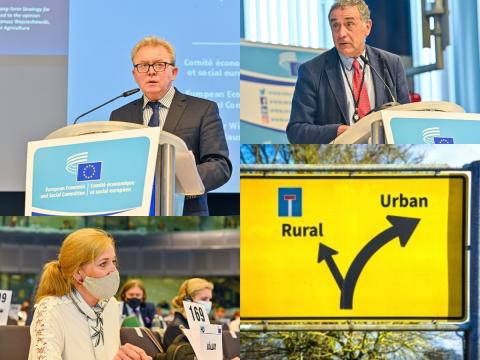
The EESC is calling on policy-makers to implement a comprehensive and holistic strategy for balanced, cohesive, equitable and sustainable rural and urban development. This will involve harnessing the role of local communities, boosting traditional industries and creating new economic activities and job opportunities in rural areas, while fostering synergies with urban areas. The opinion adopted on this topic will contribute to the implementation of the Commission's long-term vision for the EU's rural areas put forward last June.
Welcoming the European Commissioner for Agriculture, Janusz Wojciechowski, to the EESC plenary session on 21 October, EESC President Christa Schweng said that the EESC had been stressing for years the need to reduce the development gap between rural and urban areas.
"We need to ensure that no areas or citizens are left behind in the just transition to a climate-neutral, sustainable and prosperous European Union," said Ms Schweng. "As demonstrated during the COVID-19 crisis, EU rural areas play a critical role in providing economic stability through delivering crucial services such as food production. Nevertheless, they are still lagging behind and have featured less and less on the political agenda compared to towns and cities."
Given this vital role they play, the EESC emphasises the urgent need to act now and implement a paradigm shift for rural areas, bearing in mind that they represent almost 30% of the EU's population and over 80% of its territory.
Mr Wojciechowski stressed that: "With the Long-term Vision, the European Commission is attempting to enable political decisions that take a long-term view of challenges and opportunities that take into account the wide complexity of European rural areas and that take on board the full range of views and voices within rural communities. That is why the participation of the European Economic and Social Committee, and the wide range of voices you represent, is so important. If we share this Vision, and share the work required to bring it to reality, I believe that we can look forward to success."
Levelling the playing field between rural communities and the urban environment
The challenges faced by rural areas (such as demographic change, depopulation, the digital divide, low incomes, limited access to certain services, the need for better employment prospects and specific impacts of climate change) can only be addressed from a holistic and renewed place-based perspective that seeks out a reciprocal as well as complementary rural/urban relationship for development.
The EESC opinion on the topic: Towards a holistic strategy on sustainable rural/urban development makes several recommendations, based on multi-stakeholder involvement and a "bottom-up" approach, which are key ingredients for ensuring sustainability and local ownership of rural policies.
Piroska Kállay, co-rapporteur for this opinion stressed that: The supply of jobs, training and housing should reflect and harness rural natural resources, while also creating innovative business opportunities. Promoting decent work and improving working conditions in rural areas is essential. Everyone involved should have a say in this improvement process, for example through rural parliaments: we must ensure participatory democracy!
Cross-cutting coordination and tailored policies are crucial
All policies in this area must be consistent with and complementary to European strategies such as the European Green Deal, and the Farm to Fork and Biodiversity Strategies, as well as the New Industrial Strategy, which points to the agri-food sector as one of the key strategic ecosystems in the EU. Experimenting with new forms of urban-rural cooperation is not only a prerequisite but also an opportunity for a just transition and territorially balanced sustainable development.
It is essential to move towards an integrated approach to action and funding in the different policies that have an impact on rural areas, with the objective of achieving well-being and quality of life for citizens, pointed out rapporteur Josep Puxeu Rocamora. A sufficient supply of good-quality services, housing, energy, leisure, education and training, lifelong learning and healthcare systems is also necessary to ensure that rural areas are not only sustainable but also attractive places to live. The quality of life in the rural world will be measured by the increase in the number of young people and new initiatives that provide quality, well-paid jobs, he concluded.
Work organisation
Downloads
-
Dealing with sustainable and balanced rural and urban development the key to EU citizens' well-being, says EESC
Recommended for you
Rolul activ al societății civile organizate este esențial pentru o UE rezilientă
News
CESE a organizat, în sesiune plenară, o dezbatere privind importanța tot mai mare a societății civile organizate și a orașelor în asigurarea capacității Europei de a face față șocurilor asimetrice și…
Crearea în comun a serviciilor publice în sectorul sănătății va contribui la o democrație mai participativă în UE
News
Acest eveniment, organizat de Comitetul Economic și Social European (CESE) și de Universitatea din Debrecen, a evidențiat importanța crucială a creării în comun a serviciilor de interes general în…
Pentru a combate schimbările climatice, UE are nevoie de mai multe investiții publice în infrastructura energetică
News
Într-un aviz adoptat în sesiunea plenară din septembrie, Comitetul Economic și Social European (CESE) consideră că, pentru a realiza tranziția energetică și obiectivele climatice, sunt necesare…
Energie – CESE avertizează cu privire la crearea de noi dependențe
News
Într-un aviz adoptat în sesiunea sa plenară din septembrie Comitetul Economic și Social European (CESE) adoptă o poziție fermă în domeniul energiei: propunerea Comisiei reprezintă un pas în direcția…
Tranziția digitală trebuie să fie echitabilă: drepturile omului și controlul uman asupra mașinii trebuie să rămână valori fundamentale
News
Comitetul Economic și Social European (CESE) subliniază oportunitățile oferite de revoluția digitală, dar avertizează și cu privire la riscuri: implementate prea rapid, soluțiile digitale pot duce la…