An initiative of the Civil Society Organisations’ Group in cooperation with Friends of the Earth Europe
-
Location
EESC headquarters, JDE building, Rue Belliard/Belliardstraat 99-101
Brussels
Belgium
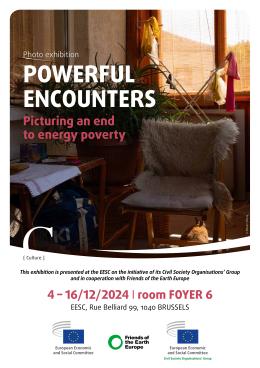
The European Economic and Social Committee (EESC) presented the photo exhibition ‘Powerful Encounters: Picturing an end to energy poverty’ on the initiative of its Civil Society Organisations’ Group and in cooperation with Friends of the Earth Europe. The work of photographer Miriam Strong was exhibited from 4 to 16 December 2024 at the EESC’s premises in Brussels.
New mandate, new challenge - reaffirming TSD amid economic security ambitions
Location
Brussels
Belgium
The third edition of the EESC Civil Society Forum on Trade and Sustainable Development (TSD) took place on Thursday, 5 December, from 13:45 to 17:30 at the EESC premises in Brussels. Under the theme "New mandate, new challenge: reaffirming TSD amid economic security ambitions," this year's Forum focused on ensuring that the EU's economic security agenda is consistent with and delivers for TSD. As we welcome a new EU Commission, this is the moment to influence policy direction and ensure that trade policy fosters resilience and security alongside long-term development and social justice for all partners.
On 15 November the EESC will host a pivotal event focusing on the benefits of organic food and the critical role of public procurement in advancing sustainable practices. This event will bring together representatives from cities, national governments, and institutions to discuss the future of organic farming and its impact on farmers, workers, the climate, and the environment.
EESC, JDE 61, Rue Belliard/Belliardstraat 99| 1040 Bruxelles/Brussels | Belgium
The fifth meeting of the EU-Armenia Civil Society Platform (CSP) is scheduled to be held on 15 October 2024 in Brussels.
The meeting will focus on assessing progress in the implementation of the EU-Armenia Comprehensive and Enhanced Partnership Agreement (CEPA), with a strong emphasis on its impact in the Areas of Democracy, Rule of Law, Anti-Corruption, and Human Rights.
This event will explore how circular economy and bioeconomy can drive sustainable agri-food systemsdevelopment across both rural and urban areas in the EU, through the presentation of innovative approaches that support the balanced development of rural and urban communities
Residence Palace and EESC's Jacques Delors building
Brussels
Belgium
The European Sustainable Development Network (ESDN) is organizing the Conference in cooperation with the Belgian Federal Institute for Sustainable Development and the European Economic and Social Committee. The Conference will be an official event of Belgium’s EU Council Presidency.
As we find ourselves just over the halfway point to reaching the 2030 Agenda and the SDGs, with only six more years left, the ESDN and co-organizers will focus this year’s Conference on transformative policies.
On 12 June 2024, the EESC will hold a public hearing in connection with its ongoing opinion on Aligning the circular economy and the bioeconomy at EU and national level which aims to enhance the synergy between bioeconomy, circularity, and sustainability by adopting a more integrated and systemic perspective on the circular bioeconomy.