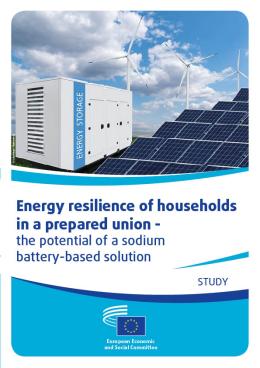
This study examines the potential of sodium ion battery technology to strengthen energy resilience in European households and businesses, particularly in meeting a 72 hour electricity self sufficiency objective under the EU’s preparedness strategy.
This study examines how social partners and civil society organisations in six Member States — Italy, Austria, Hungary, Poland, Portugal and Sweden — view the effectiveness of current policies in raising employment levels and increasing adult participation in training. It also puts forward recommendations for improving policy outcomes.
On 8 June 2022 the Consultative Commission on Industrial Change (CCMI) celebrated its 20th anniversary with a conference focused on the challenges of today and the prospects for tomorrow. This publication is a record of the occasion and a commemoration of what CCMI has achieved since joining the EESC.
Innovation is the real driver of growth and the key to creating employment, developing novel technologies and finding new solutions to tackle the challenges we face today and thus to increase competitiveness
Focussing on five EU Member States (Belgium, Bulgaria, France, Italy and Portugal), this study aims to provide a comprehensive overview of the role and increasing significance of the national Economic and Social Councils (NESCs), while also putting forward a set of policy recommendations on how to involve the NESCs more constructively, and how to make sure that the EESC's relationship with the NESCs, and henceforth its involvement as the EU's institutional bridge with civil society, can be further strengthened.
This resolution presents recommendations of the European Economic and Social Committee to the legislature 2024-2029. They are based on discussions with social partners and civil society organizations from all walks of life, including young people during the first EESC Civil Society Week, and contain a comprehensive set of actionable steps to strengthen and safeguard democratic principles.
On 20 February 2024 in Brussels, the EESC organised a conference on the Housing Crisis in Europe. This publication sets out the participants' assessment of the current state of affairs and their recommendations on how to tackle the current housing crisis.
Recent economic shocks from the COVID-19 pandemic and the energy crisis in Europe following Russia’s invasion of Ukraine have brought energy poverty to the forefront of social and political debate. While EU policies increasingly address energy poverty, gender considerations remain overlooked. This study addresses this gap and aims to increase the understanding of the gender-energy poverty nexus, analysing existing literature and EU and national policies.