For the 16th time, the European Economic and Social Committee (EESC) and Montenegro held the Civil Society Joint Consultative Committee (JCC). The JCC is a civil society platform established between the EESC and Montenegrin civil society. It complements with a civil society point of view the EU institutional framework related to the Stabilisation and Association Agreement between the EU and Montenegro. This joint institution allows civil society organisations on both sides to monitor the country's accession negotiations. It is also a platform to discuss issues of common interest and to inform the public at large on the challenges ahead during the accession period.
This 16th JCC took place in Podgorica and tackled issues such as:
Current state of play in EU-Montenegro relations, including 2022 Montenegro Report
Revised enlargement methodology – Cluster 1: The Fundamentals of the Accession Process, with a special focus on Judiciary and Fundamental rights and the Functioning of democratic institutions
Revised enlargement methodology – Cluster 1: The Fundamentals of the Accession Process, with a special focus on Justice, Freedom and Security
Overview of the civil society situation in Montenegro
A joint declaration was adopted at the meeting and will be distributed to all relevant EU institutions, as well as to the Montenegrin authorities.
Statement by Christa Schweng, president of the European Economic and Social Committee (EESC), and Dimitris Dimitriadis, president of the Section for External Relations (REX)
Statement by Christa Schweng, president of the European Economic and Social Committee (EESC), and Dimitris Dimitriadis, president of the Section for External Relations (REX)
The EU-Serbia Joint Consultative Committee (JCC) will hold its 14th meeting on 29 November 2022 in Belgrade, Serbia. It is a platform established within the institutional framework of the EU‑Serbia Stabilisation and Association Agreement (SAA), enabling representatives of both the EU and the Serbian civil society to monitor the country's accession negotiations, discuss issues of common interest and point out concerns to be tackled on the Serbian path towards the European Union.
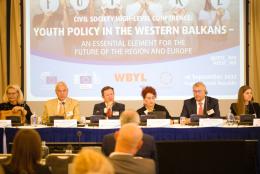
The Western Balkans Civil Society High-Level Conference brought together EESC members, civil society representatives from the countries of the Western Balkans, as well as Czech officials and members of organised civil society. The conference complemented the work the EESC has already been undertaking by organising the Western Balkans Civil Society Forum every two years since 2006.
The main topics on the agenda were:
European path for the Western Balkans: Roadmap towards clear accession perspective and the role of young people
Contribution of civil society to youth policy in the Western Balkans: challenges and opportunities in building a better future for the Western Balkans and amplifying the voice of young people from the Western Balkans
Human capital development in the Western Balkans
Youth employment challenges in the Western Balkans
Young people in the Western Balkans as an important force in regional cooperation and promoting European integration
The high-level civil society conference on youth policy in the Western Balkans, hosted by the European Economic and Social Committee (EESC), highlighted the key role of young people for the future of the region and called for their active involvement in policy-making.
Pentru a asigura un viitor mai prosper pentru cetățenii lor, guvernele din Balcanii de Vest trebuie să abordeze problemele cu care se confruntă tinerii, care dețin cheia unui astfel de viitor. Alocările bugetare suficiente și transparente pentru dezvoltarea politicii de tineret și includerea tinerilor în procesul de aderare la UE reprezintă o condiție prealabilă pentru facilitarea unor schimbări pozitive și îmbunătățirea situației tinerilor din regiune.
Hearing with Civil Society from Bosnia and Herzegovina
Location
Skenderija 3a
Sarajevo
Bosnia & Herzegovina
This years' meeting of the EESC's Western Balkans Follow-up Committee outside of Brussels took place on 24 May 2022 in the Delegation of the European Union in Sarajevo, Bosnia and Herzegovina, and included a hearing with the civil society organisations (CSOs).
For the 15th time, the European Economic and Social Committee (EESC) and Montenegro held the Civil Society Joint Consultative Committee (JCC). It took place in Brussels and tackled issues such as: Current state of play in EU-Montenegro relations including 2021 Montenegro Report / Revised enlargement methodology – Cluster 1: The Fundamentals of the Accession Process, with a special focus on Economic Criteria, Public procurement, Statistics and Financial Control and the response to the COVID-19 pandemic / Overview of the civil society situation in Montenegro.
A joint declaration was adopted at the meeting and distributed to all relevant EU institutions, as well as to the Montenegrin authorities.
Chamber of Commerce and Industry of Serbia
Resavska 13 – 15
Belgrade
Serbia
It is a platform established within the institutional framework of the EU‑Serbia Stabilisation and Association Agreement (SAA), enabling representatives of both the EU and the Serbian civil society to monitor the country's accession negotiations, discuss issues of common interest and point out concerns to be tackled on the Serbian path towards the European Union.
The EESC's Western Balkans Civil Society Forum, which took place in Skopje on 30 September and 1 October, put the spotlight on the need for a clear EU accession perspective for the region and the role civil society should play in this process.