
European Economic
and Social Committee
Speech by President Séamus Boland, EESC plenary debate with Roxana Mînzatu, European Commission Executive Vice-President for Social Rights and Skills, Quality Jobs and Preparedness
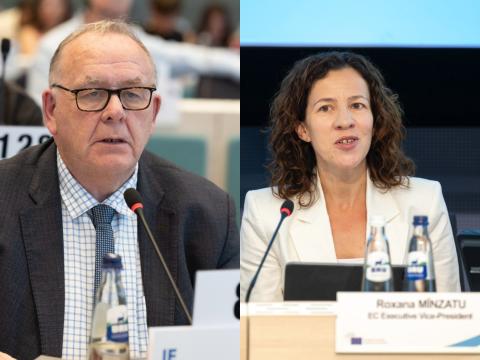
EESC plenary debate on the new action plan for the European Pillar of Social Rights
Dear Executive Vice-President, Federal Minister and Deputy Minister,
Thank you all for taking the time to be with us today, it is much appreciated;
It is a particular pleasure to see you Ms Mînzatu, after our meeting in March;
And of course, we will have the pleasure of welcoming you to our Group meeting in September.
At last month's plenary, I gave quite an impassioned speech, on how I am proud to be European;
My colleagues will remember that we were discussing the geo-political challenges facing the EU;
Today my discourse will be different;
In discussing 'poverty alleviation', which falls within the remit of the Pillar, I have to admit that I am not proud of being European;
I am not proud, because 94 million people are daily at risk of poverty or social exclusion within the EU;
I am not proud, because more than one quarter of children living in the Union, face poverty or social exclusion;
And I am not proud, it will have taken us nearly 80 years to finally launch an EU anti-poverty strategy;
I hope that this strategy, to be adopted early next year, will see a swifter implementation!
Although today's debate focusses on the European Pillar of Social Rights, I am taking this opportunity to go a step further and to comment on the forthcoming EU anti-poverty strategy that you Ms Mînzatu, will oversee;
The first point that I would like to make, is that this new strategy should be bold enough to approach and to define poverty through the lens of fundamental human rights;
Put simply, avoiding poverty should be a right, not a question of charity;
We have already seen moves towards rights-based approaches on several policy areas – for example, in relation to the right to food, health, energy and housing;
Now is time for the EU to push for a mental paradigm shift in our societies and to move towards the right to a life without poverty;
We are already behind – as early as 1998, the UN set up the post of 'Special Rapporteur on extreme poverty and human rights', so we are acting a mere 30 years later!
The reality is, that being poor involves much more than material deprivation;
It affects one's dignity, opportunities and social integration;
There is even a little known-term – 'Aporophobia'- which describes the aversion, fear, systemic discrimination and stigma by society against poor people;
Ladies and gentlemen, the upcoming EU Anti-Poverty Strategy is a crucial opportunity to be seized, to change our attitude to and management of poverty within our societies.
The second point that I would like to make is that poverty is not irreversible;
Without doubt, poverty is a trap, that often starts at an early age and continues from one generation to the next;
And I would like to quote Ms Mînzatu, who in her confirmation hearing and written response to the European Parliament, stated that "The starting point (of the EU Anti-Poverty Strategy) must be the root causes of poverty";
I fully agree and with that objective in mind, I will briefly enumerate a number of proposals that I believe the forthcoming strategy should include;
For example, integrating binding targets for poverty reduction, with local, national and European action plans working hand in hand;
Introducing poverty checks into all EU policies;
Improving poverty measurement methodologies, to also include what have been referred to as the 'missing poor' – for example, homeless people, Roma, undocumented migrants etc;
Focussing on data collection on intersectional poverty;
And last, but certainly not least: directly involving and supporting relevant civil society organisations, in particular representatives of people who are themselves experiencing poverty.
I will bring my comments to a close by acknowledging that discussing poverty eradication alongside European security, defence and competitiveness is not an easy task;
But it is wise approach, because poverty leads to both apathy and to dangerous political extremism;
We already have enough of both of those in today's world;
My plea to you today is that the defence of democracy, rights and poverty eradication must be pursued together, as one singular objective!
Thank you for your attention.
Work organisation
Downloads
-
Speech by President Séamus Boland
Recommended for you
Rolul activ al societății civile organizate este esențial pentru o UE rezilientă
News
CESE a organizat, în sesiune plenară, o dezbatere privind importanța tot mai mare a societății civile organizate și a orașelor în asigurarea capacității Europei de a face față șocurilor asimetrice și…
Crearea în comun a serviciilor publice în sectorul sănătății va contribui la o democrație mai participativă în UE
News
Acest eveniment, organizat de Comitetul Economic și Social European (CESE) și de Universitatea din Debrecen, a evidențiat importanța crucială a creării în comun a serviciilor de interes general în…
Pentru a combate schimbările climatice, UE are nevoie de mai multe investiții publice în infrastructura energetică
News
Într-un aviz adoptat în sesiunea plenară din septembrie, Comitetul Economic și Social European (CESE) consideră că, pentru a realiza tranziția energetică și obiectivele climatice, sunt necesare…
Energie – CESE avertizează cu privire la crearea de noi dependențe
News
Într-un aviz adoptat în sesiunea sa plenară din septembrie Comitetul Economic și Social European (CESE) adoptă o poziție fermă în domeniul energiei: propunerea Comisiei reprezintă un pas în direcția…
Tranziția digitală trebuie să fie echitabilă: drepturile omului și controlul uman asupra mașinii trebuie să rămână valori fundamentale
News
Comitetul Economic și Social European (CESE) subliniază oportunitățile oferite de revoluția digitală, dar avertizează și cu privire la riscuri: implementate prea rapid, soluțiile digitale pot duce la…