
European Economic
and Social Committee
Speech by President Séamus Boland, EESC plenary debate with Roxana Mînzatu, European Commission Executive Vice-President for Social Rights and Skills, Quality Jobs and Preparedness
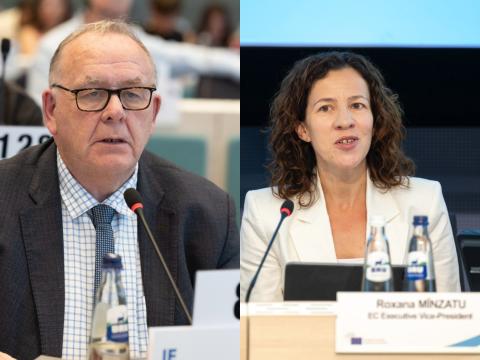
EESC plenary debate on the new action plan for the European Pillar of Social Rights
Dear Executive Vice-President, Federal Minister and Deputy Minister,
Thank you all for taking the time to be with us today, it is much appreciated;
It is a particular pleasure to see you Ms Mînzatu, after our meeting in March;
And of course, we will have the pleasure of welcoming you to our Group meeting in September.
At last month's plenary, I gave quite an impassioned speech, on how I am proud to be European;
My colleagues will remember that we were discussing the geo-political challenges facing the EU;
Today my discourse will be different;
In discussing 'poverty alleviation', which falls within the remit of the Pillar, I have to admit that I am not proud of being European;
I am not proud, because 94 million people are daily at risk of poverty or social exclusion within the EU;
I am not proud, because more than one quarter of children living in the Union, face poverty or social exclusion;
And I am not proud, it will have taken us nearly 80 years to finally launch an EU anti-poverty strategy;
I hope that this strategy, to be adopted early next year, will see a swifter implementation!
Although today's debate focusses on the European Pillar of Social Rights, I am taking this opportunity to go a step further and to comment on the forthcoming EU anti-poverty strategy that you Ms Mînzatu, will oversee;
The first point that I would like to make, is that this new strategy should be bold enough to approach and to define poverty through the lens of fundamental human rights;
Put simply, avoiding poverty should be a right, not a question of charity;
We have already seen moves towards rights-based approaches on several policy areas – for example, in relation to the right to food, health, energy and housing;
Now is time for the EU to push for a mental paradigm shift in our societies and to move towards the right to a life without poverty;
We are already behind – as early as 1998, the UN set up the post of 'Special Rapporteur on extreme poverty and human rights', so we are acting a mere 30 years later!
The reality is, that being poor involves much more than material deprivation;
It affects one's dignity, opportunities and social integration;
There is even a little known-term – 'Aporophobia'- which describes the aversion, fear, systemic discrimination and stigma by society against poor people;
Ladies and gentlemen, the upcoming EU Anti-Poverty Strategy is a crucial opportunity to be seized, to change our attitude to and management of poverty within our societies.
The second point that I would like to make is that poverty is not irreversible;
Without doubt, poverty is a trap, that often starts at an early age and continues from one generation to the next;
And I would like to quote Ms Mînzatu, who in her confirmation hearing and written response to the European Parliament, stated that "The starting point (of the EU Anti-Poverty Strategy) must be the root causes of poverty";
I fully agree and with that objective in mind, I will briefly enumerate a number of proposals that I believe the forthcoming strategy should include;
For example, integrating binding targets for poverty reduction, with local, national and European action plans working hand in hand;
Introducing poverty checks into all EU policies;
Improving poverty measurement methodologies, to also include what have been referred to as the 'missing poor' – for example, homeless people, Roma, undocumented migrants etc;
Focussing on data collection on intersectional poverty;
And last, but certainly not least: directly involving and supporting relevant civil society organisations, in particular representatives of people who are themselves experiencing poverty.
I will bring my comments to a close by acknowledging that discussing poverty eradication alongside European security, defence and competitiveness is not an easy task;
But it is wise approach, because poverty leads to both apathy and to dangerous political extremism;
We already have enough of both of those in today's world;
My plea to you today is that the defence of democracy, rights and poverty eradication must be pursued together, as one singular objective!
Thank you for your attention.
Work organisation
Downloads
-
Speech by President Séamus Boland
Recommended for you
EWSA: Die EU muss die soziale Nachhaltigkeit stärker ins Blickfeld rücken
News
Der Europäische Wirtschafts- und Sozialausschuss (EWSA) fordert die Europäische Kommission auf, einen längst überfälligen Bericht zu veröffentlichen und die Ausweitung des Anwendungsbereichs der EU…
Ko-Kreation von Dienstleistungen von allgemeinem Interesse im Bereich Gesundheit als Beitrag zur Stärkung der partizipativen Demokratie in der EU
News
Bei dieser vom Europäischen Wirtschafts- und Sozialausschuss (EWSA) und der Universität Debrecen organisierten Veranstaltung wurde hervorgehoben, wie wichtig die Ko-Kreation von Dienstleistungen von…
Zur Bekämpfung des Klimawandels werden mehr öffentliche Investitionen in die Energieinfrastruktur in der EU gebraucht
News
In einer auf der Plenartagung im September verabschiedeten Stellungnahme erläutert der Europäische Wirtschafts- und Sozialausschuss (EWSA), dass zur Verwirklichung der Energiewende und der Klimaziele…
Energie – EWSA warnt vor neuen Abhängigkeiten
News
Der Europäische Wirtschafts- und Sozialausschuss (EWSA) bezieht in einer auf seiner September-Plenartagung verabschiedeten Stellungnahme klar Stellung zum Thema Energie: Der Vorschlag der Kommission…
Der EU-US-Handels- und Technologierat muss die Dynamik nutzen, um ein Wegweiser für Handel, Technologie und Innovation zu werden
News
Auf seiner Juli-Plenartagung zeigte sich der Europäische Wirtschafts- und Sozialausschuss (EWSA) optimistisch, dass der neue Handels- und Technologierat (TTC) ein innovatives Instrument für die EU…