
European Economic
and Social Committee
Civil Society Organisations' Group of EESC appoints new president
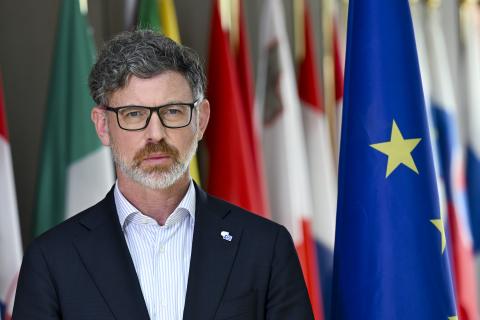
Cillian Lohan is the new President of the Civil Society Organisations' Group of the European Economic and Social Committee (EESC). The Group appointed the environmentalist for the 2025-2028 term. Peace, democracy and resilient communities will take centre stage during his presidency.
With the start of the EESC's new term (2025-2030), Cillian Lohan takes over the presidency of the EESC Civil Society Organisations' Group. The Group's 110 members elected the Irishman for a term of two and a half years. The election took place on 21 October, during the Group's first meeting following the Committee's renewal. Cillian Lohan has been representing the Green Economy Foundation and the Irish Environmental Pillar at the EESC since 2015. He was one of the initiators and inaugural chair of the European Circular Economy Stakeholder Platform, and served as EESC vice-president for communication from 2020 to 2023. As the new president of the Group, he succeeds Séamus Boland, who chaired the Group from October 2020.
Following his nomination, Cillian Lohan said: I am honoured and excited to start my term as President of the Civil Society Organisations' Group. I am enthusiastic about getting to know and tapping the full potential of our Group. Our last new term started under the restrictions of lockdowns and COVID-19. This time we can hit the ground running.
Having worked in the NGO sector for more than a decade, Mr Lohan had two clear goals in running for this position:
- Achieving the genuine involvement of civil society organisations in EU policy-making by strengthening the Group's influence and impact;
- Contributing to an EU that functions and is accepted at community level.
In that sense, he has a clear message to the representatives of civil society organisations from the 27 EU Member States in his Group, and their networks and partners: We are here to help civil society organisations and individuals working with a civil society organisation or volunteering reach the decision-makers in the EU. As members, we live and work within our cities, towns and villages. This gives us the opportunity to help develop more efficient EU policies, policies that truly address people’s needs, and are therefore better accepted by our communities and implemented more easily.
In his address, Cillian Lohan also announced the thematic cornerstones of his presidency:
- Peace;
- Democracy;
- Resilient communities,
which he aims to develop in a collaborative approach. The Group will address these issues through the lens of sustainable development, as enshrined in the United Nations' Agenda 2030.
More information on the new President of the EESC's Civil Society Organisations' Group is available here: Cillian Lohan – Bio notes
Cillian Lohan will chair the EESC's Civil Society Organisations' Group together with seven vice-presidents: Krzysztof Balon from Poland (European Anti-Poverty Network Poland and Working Community of Associations of Social Organisations), Pietro Vittorio Barbieri from Italy (Centre for Autonomy), Juliane Neiiendam from Denmark (Women’s Council Denmark and Danish Engineers Council), Rudolf Kolbe from Austria (Austrian Federal Conference of the Liberal Professions and Austrian Federal Chamber of Architects and Chartered Engineers), Katrīna Leitāne from Latvia (National Youth Council), Lidija Pavić-Rogošić from Croatia (ODRAZ), and Ariane Rodert from Sweden (Church of Sweden).
Background:
The Civil Society Organisations' Group is made up of a wide range of representatives and stakeholders from the economic, civic, professional and cultural fields, including farmers', consumers' and environmental organisations, the professions, social economy actors, associations representing persons with disabilities, women, young people and many others. Members are nominated by their national governments and then appointed by the Council of the European Union. They then work independently in the interests of all EU citizens. During the 2025-2030 term, the Group will consist of 110 members, including 42% new members.
Unlike EESC members, who are elected for a five-year term of office, presidencies are elected for a term of two and a half years. Presidential terms are linked to the EESC's renewal and mid-term renewal. The new presidencies will therefore last until April 2028.
Work organisation
Downloads
-
PR - Civil Society Organisations' Group of EESC appoints new president
-
Bio notes - Cillian Lohan