
European Economic
and Social Committee
A new check to enhance competitiveness
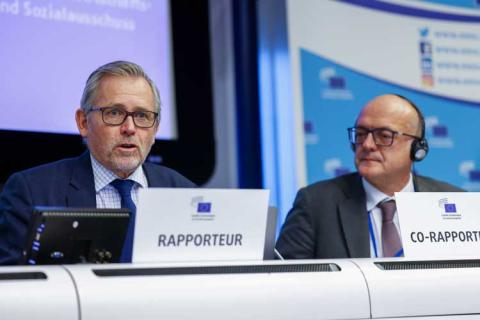
We all know that competitive businesses are crucial. They create value - for themselves and for society at large. Only competitive businesses can secure the green transition and preserve and create new high-quality jobs.
But what is the competitiveness of businesses and how can we enhance it?
No single definition exists, but it can be described as a company's ability to succeed in the market in a profitable way. The availability of production factors, such as a skilled workforce, energy, raw materials and capital is important here, as are the overall production costs, the demand and markets for the products, and the capacity to innovate and seize opportunities.
Unfortunately, the EU is becoming less and less competitive. Its share of the global economy has been falling for quite some time. Today, the global GDP is around 15%. In 2050, it will be less than 10%. The consequences will be felt.
We must also add the current looming global recession, Russia's aggressive war in Ukraine, disruptions in supply chains, a weakened order situation, rising inflation and high energy prices to this negative long-term perspective.
But this picture is not all gloom. Unique opportunities, driven by the green transition, exist. Europe's ability to innovate is vital for the green transition. The following three points to help the green transition are of particular importance:
Europe must win the global race for skills. It's as much about finding and retaining people with the right skills as it is about finding people who are prepared to work in places that are sometimes far away from urban areas. We need not only better skills alignment in education and better mobility within the EU, but also the ability for companies to recruit the right staff from all over the world.
Access to raw materials and energy. The aim is to make Europe less susceptible to geopolitical risks. For this, it is essential to create a competitive market within the EU for the exploration for and the extraction and refining of metals and minerals. Any legislation on this matter needs to strengthen the attractiveness for exploration while also balancing high environmental standards.
Permits must be easier and quicker to obtain. Today, permit procedures for industrial operations or for hiring staff from third countries take far too long and often end with an outcome which is to the detriment of the company in question, with negative effects far beyond.
The new competitiveness check should be seen as a tool to make sure that proposals support increased competitiveness, more jobs and sustainable growth. It should be a key part of balanced EU decision-making and should be applied in the context of any EU policy and law-making process.
It should consider the impact on businesses, employment, working conditions at various levels, including compliance costs and other direct effects, multiplier impacts on value chains, and their consequent macro-economic impacts. In this regard, attention should be paid to the competitive position of the wide variety of enterprises in terms of sector, size and business model, including social economy enterprises.
The competitiveness check would consist of two levels.
Technical level, or impact assessment level. This is where the European Commission currently assesses how proposed legislation affects other policy areas, in line with its current better regulation guidelines and toolbox. In this context, the assessment on how initiatives affect the competitiveness of European businesses and of the EU as a whole must be significantly reinforced and made mandatory.
Political level, or decision-making level. The European Commission must, when shaping new initiatives, pay due attention to competitiveness and give it the proper weight it deserves. This could be described as establishing a competitiveness-sensitive mindset.
While the main focus of the competitiveness check is on initiatives with primary objectives other than improved competitiveness, we also believe the time has come for preparing a specific competitiveness agenda, with the long-term goal of enhancing the EU's competitiveness.
At present, there is an unfortunate lack of more systematic thinking about competitiveness at European level. Businesses are suffocating under the weight of new legislation that primarily pursues objectives other than improving competitiveness, and which adds to the excessive cumulative burden imposed on businesses in recent years. This must change.
The Swedish Presidency will place a significant focus on competitiveness, and is likely to organise an informal summit on the issue.
Let us, as we say in my country, strike while the iron is hot.
Christian Ardhe,
Member of the EESC Employers’ Group Rapporteur of the opinion INT/1000 “A competitiveness check to build a stronger and more resilient EU economy"