
European Economic
and Social Committee
Decentralised and Agentic AI: boosting innovation, competitiveness and responsible AI
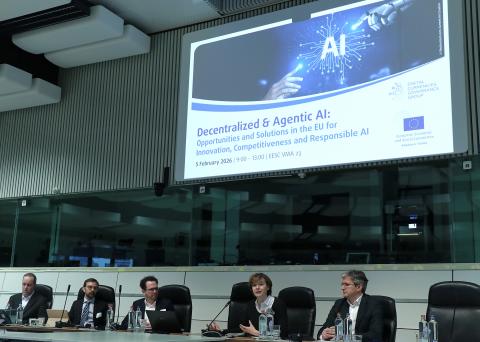
On 5 February 2026, the EESC Employers' Group hosted a high-level policy roundtable, organised by the Digital Currencies Governance Group (DCGG) titled "Decentralised & Agentic AI: Opportunities and Solutions in the EU for Innovation, Competitiveness and Responsible AI". The event brought together policymakers, regulators, industry leaders, and academia to discuss how Europe approaches the rapidly advancing field of AI.
The message was clear: it is time for Europe to move beyond fear and hesitation about AI. “Artificial intelligence is not a threat to be managed, but a strategic lever that must be understood, shaped and actively used to strengthen Europe’s competitiveness” stated Sandra Parthie, EESC Employers' Group Group's President. "Today, more than 80% of European companies see AI as strategically important, yet only a few have taken concrete steps to integrate the technology into their operations. The gap is not conceptual, it is practical. Businesses need simpler rules, faster deployment and a clear signal: we choose innovation, not hesitation" she continued.
For Europe, the real risk today is not over-engaging with AI, but fragmenting responses and delayed deployment in the real economy. The central question is how to move from strategy to large-scale implementation.
From the Employers’ Group perspective, this requires a decisive shift in mindset. AI should not be treated primarily as a regulatory issue, but as an economic and industrial opportunity. Regulation remains necessary to ensure trust, legal certainty and responsibility. However, when it is overly complex, cumulative or disconnected from business realities, it risks slowing down precisely those actors Europe needs most: innovators, SMEs and scale-ups.
What they need is simpler access to funding, reduced administrative burdens, predictable intellectual property rules and regulatory proportionality. This is why the Employers' Group call for a clear political signal that Europe is open to innovation and determined to compete globally, not merely regulate locally.
This will also boost investments. As Michal Boni, EESC Employers' Group member and key speaker at the event, said: “Real investment is fundamental, but we must address expectations and companies' efforts. Companies will be more open to investment when the ecosystem of AI is simpler, with clear rules and tangible advantages. For now, we need a new timetable and better conditions, especially adapted to the capabilities of SMEs.”
Decentralised and agentic AI offers new ways to enhance innovation, security and societal resilience. Rather than resisting these advances, Europe should aim to shape them, ensuring that governance frameworks enable experimentation while safeguarding trust. The AI Act provides a sound foundation in this regard, but emerging developments such as agentic AI, sustainability imperatives, and cyber resilience will require continuous attention and adaptive governance.
The question is not about choosing between innovation and responsibility. It is about recognising that Europe can only remain competitive, sovereign and socially sustainable if it learns to embrace artificial intelligence with confidence, clarity and ambition.
The task ahead is to turn caution into capability, and potential into concrete economic value.
Recommended for you
Rolul activ al societății civile organizate este esențial pentru o UE rezilientă
News
CESE a organizat, în sesiune plenară, o dezbatere privind importanța tot mai mare a societății civile organizate și a orașelor în asigurarea capacității Europei de a face față șocurilor asimetrice și…
Crearea în comun a serviciilor publice în sectorul sănătății va contribui la o democrație mai participativă în UE
News
Acest eveniment, organizat de Comitetul Economic și Social European (CESE) și de Universitatea din Debrecen, a evidențiat importanța crucială a creării în comun a serviciilor de interes general în…
Pentru a combate schimbările climatice, UE are nevoie de mai multe investiții publice în infrastructura energetică
News
Într-un aviz adoptat în sesiunea plenară din septembrie, Comitetul Economic și Social European (CESE) consideră că, pentru a realiza tranziția energetică și obiectivele climatice, sunt necesare…
Energie – CESE avertizează cu privire la crearea de noi dependențe
News
Într-un aviz adoptat în sesiunea sa plenară din septembrie Comitetul Economic și Social European (CESE) adoptă o poziție fermă în domeniul energiei: propunerea Comisiei reprezintă un pas în direcția…
Tranziția digitală trebuie să fie echitabilă: drepturile omului și controlul uman asupra mașinii trebuie să rămână valori fundamentale
News
Comitetul Economic și Social European (CESE) subliniază oportunitățile oferite de revoluția digitală, dar avertizează și cu privire la riscuri: implementate prea rapid, soluțiile digitale pot duce la…