
European Economic
and Social Committee
A people-centred economy must remain the focus of the EU
The European Economic and Social Committee (EESC) supports efforts to develop a more human-centred and future-proof industrial ecosystem. At the same time, it calls for an in-depth debate on Industry 5.0 and its social and economic implications.
The aim of Industry 5.0 is to integrate social and environmental issues into business processes, as these were not adequately addressed in the previous phase, known as Industry 4.0, which focused mainly on digitalisation and automation. Industry 5.0, which is the subject of an opinion entitled "Industry 5.0 - how to make it happen", adopted by the European Economic and Social Committee at its October plenary session, should provide an opportunity to develop an industrial paradigm that goes beyond a purely technology-driven and growth-oriented approach. It is now clear that Industry 4.0's focus on automation has, as the EESC points out, overlooked its impact on human capital.
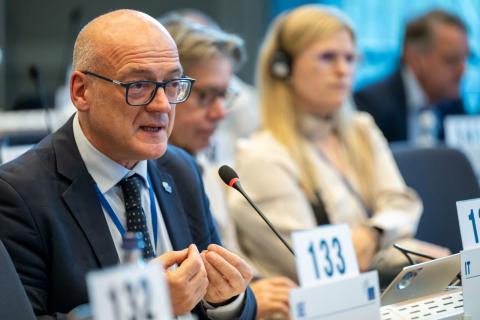
"Digital transformation can be the best way to promote the 'New Industrial Clean Deal', but along the way we want to encourage the creation of a human-centred approach based on democratic values, social equity and inclusive competitiveness," said Giuseppe Guerini, rapporteur for the opinion on Industry 5.0.
Industry 4.0 underestimated the human factor as the main contributor to the success of the production process, especially in democratic and open societies. It also paid less attention to some key dimensions of industrial production – beyond productivity – that have since become top policy priorities for the European Union, such as the need to ensure that industry has a much lighter environmental footprint by reducing waste, promoting circularity and economic resilience, and using less and greener energy. In addition, the EESC stresses that more attention should be paid to 'datafication', i.e. the tendency towards total reliance on data and algorithmic control of production processes, which has the merit of making production processes increasingly precise, but can also impoverish the creative contribution of human skills.
Industry 5.0 puts people back into the heart of production, viewing their experience, knowledge and skills as fundamental resources for a sustainable competitive advantage. It balances the benefits of automation, in terms of productivity, with the creativity and craftsmanship that are considered to be uniquely human. By focusing on the promotion of digital manufacturing as a major goal in itself, Industry 4.0 has somehow ignored the impact of thorough automation on society, jeopardising employment and undervaluing the unique contribution that humans can make to quality production. While machines can only do what they are programmed to do, people bring innovation and creativity to production processes. It is therefore important to build human-machine bridges across all factory activities, with intelligent machines supporting and augmenting human work (e.g. 'cobots' that automate the repetitive, strenuous and dangerous parts of production), allowing workers to focus on process and product design, problem solving, organisation, planning and customer service. Finally, human centricity also means increased attention to workers' health and safety at work in general, including much greater concern for workers who are – or will be – displaced by automation.
To sum up, the EESC calls on the EU institutions to support the creation of a favourable European industrial ecosystem, which must be: future-proof, human-centred, and based on democratic values, social justice, fair competition and inclusive competitiveness. While supporting Industry 5.0 as a valid approach, the EESC believes that the concept needs to be further developed in order to better define its economic, social, political, legal and technological implications. The EESC highlights existing European policies, such as the Green Deal, the Industrial Strategy, the AI Act, the Digital Decade, the European Pillar of Social Rights and the Skills Agenda, which should serve as a basis for the Industry 5.0 vision, while at the same time being updated to include Industry 5.0 principles.
The social partners have an essential role to play in the development of Industry 5.0, as worker participation and social dialogue are key to seizing the opportunities it offers. This requires the involvement of all workers at all levels, as the social partners must strive to develop a more rewarding, attractive working environment, based on healthy, creative and meaningful interaction between humans and machines.
Recommended for you
Rolul activ al societății civile organizate este esențial pentru o UE rezilientă
News
CESE a organizat, în sesiune plenară, o dezbatere privind importanța tot mai mare a societății civile organizate și a orașelor în asigurarea capacității Europei de a face față șocurilor asimetrice și…
Crearea în comun a serviciilor publice în sectorul sănătății va contribui la o democrație mai participativă în UE
News
Acest eveniment, organizat de Comitetul Economic și Social European (CESE) și de Universitatea din Debrecen, a evidențiat importanța crucială a creării în comun a serviciilor de interes general în…
Pentru a combate schimbările climatice, UE are nevoie de mai multe investiții publice în infrastructura energetică
News
Într-un aviz adoptat în sesiunea plenară din septembrie, Comitetul Economic și Social European (CESE) consideră că, pentru a realiza tranziția energetică și obiectivele climatice, sunt necesare…
Energie – CESE avertizează cu privire la crearea de noi dependențe
News
Într-un aviz adoptat în sesiunea sa plenară din septembrie Comitetul Economic și Social European (CESE) adoptă o poziție fermă în domeniul energiei: propunerea Comisiei reprezintă un pas în direcția…
Tranziția digitală trebuie să fie echitabilă: drepturile omului și controlul uman asupra mașinii trebuie să rămână valori fundamentale
News
Comitetul Economic și Social European (CESE) subliniază oportunitățile oferite de revoluția digitală, dar avertizează și cu privire la riscuri: implementate prea rapid, soluțiile digitale pot duce la…