The EESC is convinced that islands, mountainous regions and sparsely populated areas face significant challenges and that there is a solid legal basis that obliges the EU to take action in order to tackle these challenges. In this context, the organised civil society has an important role to play and through this debate, the aim is to find the best practices and solutions so that these regions can perform better and recover from the multiple crises. Therefore the EESC- ECO section has decided to organise this public debate in the framework of the EESC own-intiative opinion on "Main challenges that EU islands, mountain and sparsely populated areas face.
The ECO Section of the EESC will organise a public debate with the title: "Gender inequality in access to financial markets. Causes, consequences and policy solutions" in order to present the views of different actors and discuss on the gender gaps in the access to funding and on investment.
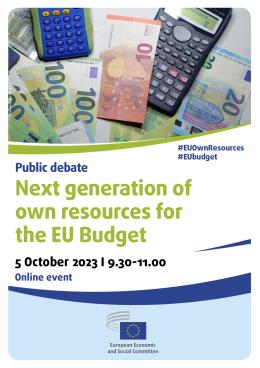
The EESC has repeatedly emphasized its support for more genuine sources of own revenue for the EU budget. This has become all the more important in the current higher interest rate environment that has left a gap in the EU budget for the repayment of the money the Union has borrowed on capital markets. The public debate will focus on the Commission´s proposal for a next generation of own resources and the related policy proposals of the EESC.
Environmental, social, and governance (ESG) investing, that is, investing which takes ESG factors into account when making investment decisions is becoming an important part of mainstream finance. ESG ratings provide an opinion on a company or financial instrument’s sustainability profile or characteristics, exposure to sustainability risks or impact on society and/or the environment. The public debate will discuss the Commission´s legislative proposal to improve the reliability, comparability and transparency of ESG ratings, and the EESC´s related policy proposals.
Jacques Delors Building - Rue Belliard 101 - 1040 Brussels - Meeting room: Atrium 5
In order to attract talents and a skilled workforce, close cooperation must be developed between regional authorities, social partner organisations, employment services, and education and training providers. Social dialogue needs to be used effectively in order to attract companies to disadvantaged regions and ensure good quality jobs, good wages, job security via standard employment and access to social protection, and lifelong learning opportunities.
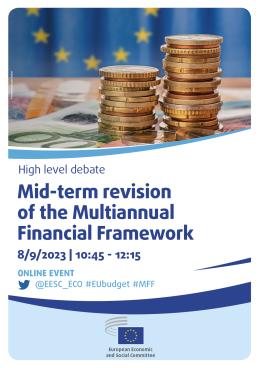
As we reach the midpoint in the current Multiannual Financial Framework (MFF), it is crucial that we take stock of our progress and adapt our plans to the evolving challenges and opportunities we face. The ECO section organise a High level debate with the European Parliament´s rapporteur, Mr Jan Olbrycht, and Mr Eric von Breska, director, DG BUDG, European Commission.
Insularity is considered to be a permanent and unchangeable geographical feature which involves additional costs (transport, energy, waste management, public services, necessity goods and services) that hamper the development and competitiveness of the islands, while particularly exposing them to biodiversity loss and climate change. The organised civil society has an important role to play and tackle all these challenges and through this debate. The aim is to find the best practices and solutions so that EU islands can preform better and recover from the multiple crises.
Policy debate with Margarida Marques, Vice chair of the Committee on Budgets (BUDG), European Parliament
Event type
Debate
Location
Online event
Brussels
Belgium
Policy debate with Margarida Marques, Vice chair of the Committee on Budgets (BUDG), European Parliament, on the upcoming Mid Term Review of the Multiannual Financial Framework and a second set of new own resources for the EU budget.
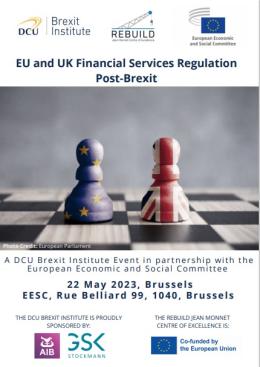
Brexit has created significant challenges for policymakers in the European Union (EU), in particular in the financial sector, as the UK is now outside its regulatory framework. The EU-UK Trade and Cooperation Agreement includes a very thin financial sector chapter and constitutes a limited basis for regulatory cooperation. The panelists will discuss recent trends in financial sector regulation across the Channel, including divergence between the EU and the UK, and the threats posed by this divergence for financial stability and the risks of further fragmentation.