
European Economic
and Social Committee
BLUE DIPLOMACY: WATER COOPERATION MUST BECOME AN EU PRIORITY
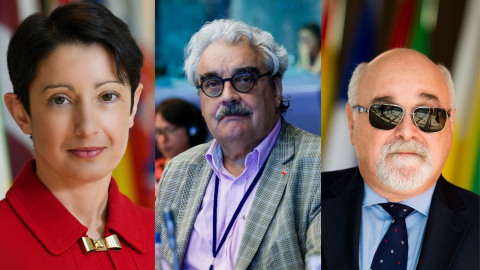
By Milena Angelova, Carlos Trindade and Ioannis Vardakastanis
EESC Info: Why does restoring the global hydrological cycle require coordinated international action, and what role should the EU play?
Milena Angelova, EESC Employers' Group: The EESC is deeply concerned about the profound and dangerous changes to the global hydrological cycle, driven primarily by accelerating climate change, unsustainable water use and land-use change. Building on its multilateral ambitions, the EU should lead international efforts to strengthen the role of international law in protecting and restoring ecosystems that sustain the hydrological cycle, such as wetlands, lakes and forests. The EU should call for a global flagship initiative at the 2026 UN Water Conference to restore the global hydrological cycle, with particular emphasis on addressing green water gaps in line with Interactive Dialogue C on Water for the Planet.
The hydrological cycle is a global public good that requires a systems-based approach at the global level, especially with regard to indicators, metrics and mapping, monitoring protocols, data sharing, and incentives that inform governance and decision-making.
The EESC suggests that the 2028–2034 EU budget include funding for the restoration of small and large hydrological cycles through cooperation and the sustainable management of shared and transboundary watersheds, maritime meadows and sponge landscapes, as well as through hydroclimatic innovations that also mitigate hydrological change.
At the European level, we need an ambitious agenda that links agriculture, water, climate, biodiversity and external relations within a single resilience strategy, making the best use of the technological revolution, AI and digitalisation.
EESC Info: Which human activities are most seriously disrupting the global hydrological cycle?
Carlos Trindade, EESC Workers’ Group: The accelerating pace of climate change, unsustainable water use, changes in land use and the emerging needs of AI data centres are among the main human-driven factors disrupting the hydrological cycle.
These disruptive factors also include extreme heat and conditions induced by El Niño, abnormal river flows, changes in reservoir levels, aquifer recharge, soil moisture and evapotranspiration, as well as the unprecedented melting of glaciers at both the poles and in high mountain regions around the world. For example, the melting of Antarctic ice affects the planet’s hydrological cycle and global precipitation patterns, with proven impacts on tropical rainfall and the distribution of moisture between the hemispheres.
In the face of these human activities and atmospheric changes, the current difficulties in implementing multilateral policies and the modest results of cross-border cooperation on the shared management of water resources severely undermine international diplomatic efforts to establish programmes aimed at addressing the current situation and restoring the planet’s hydrological cycle.
EESC Info: What does the EESC propose to help countries work together to protect shared water resources and restore the global water cycle?
Ioannis Vardakastanis, EESC Civil Society Organisations's Group: Our Committee proposes a set of actions to generate new, high-quality data, enabling us to restore and protect the global hydrological cycle more effectively by promoting multilateralism. We encourage riparian countries ─ countries sharing the same rivers or water basins ─ to develop shared arrangements and dedicated basin institutions (organisations that jointly manage shared rivers and water basins) in accordance with the Water Convention and the Watercourses Convention. We wish to stress once again that cooperation on water must be a pillar of European external action, not merely an add-on to existing policies. Blue Diplomacy efforts also need to be strengthened by promoting cooperation with the UN Special Envoy on Water. This partnership can greatly increase our capacity to act as a catalyst for a new global alliance to restore the hydrological cycle.