
European Economic
and Social Committee
COP28: Civil society to push for more to save climate
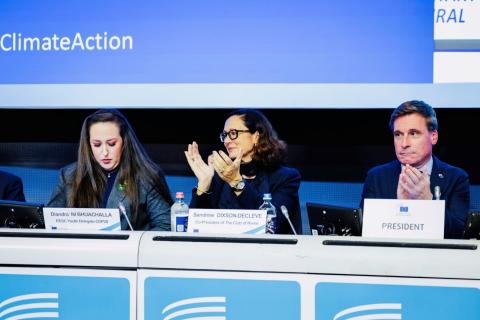
The results of the COP28 climate conference have disappointed civil society organisations. Nonetheless, they can be a springboard for further European action in the global COP forum.
The European Economic and Social Committee (EESC) vows not to let up in the fight against the climate crisis. The debate "Global climate commitments: reflecting on the outcomes of UN Framework Convention on Climate Change (UNFCCC) Conference of the Parties – COP28", organised by the European Economic and Social Committee (EESC) in Brussels on 13 December 2023, took place just hours after the end of COP28 UN Climate Conference in Dubai.
"The added value of the COP28 negotiations is the fact that, for the first time in thirty years, countries also committed to transitioning away from fossil fuels in energy systems. This a step in the right direction, but the EESC was always clear that we need to fully phase out fossil fuels. We need to be more ambitious and to make sure that the commitments are delivered on and agreements implemented. None of this can happen without the youth sitting with us at the table," said EESC President Oliver Röpke. At the same time, he highlighted the major shortcomings of the agreement, which resonated strongly in the debate.
European Union negotiators argue that, together with partners from around the world, they succeeded in Dubai in keeping alive the possibility of meeting the Paris Agreement's commitment to limit the average global temperature increase to 1.5°C above pre-industrial levels. With a particular focus on the energy sector, COP28 agreed to accelerate the transition away from fossil fuels this decade, take action to reduce emissions by 43% by 2030, and put the world on a pathway to net zero emissions by 2050, in line with the best available science. The final COP28 text recognises that targets should be set "taking into account different national circumstances", a reference to the principle that poorer countries may find it harder to cut emissions than wealthier ones.
However, the commitments made in Dubai are full of shortcomings that can be exploited by opponents of a smooth green transition. "We are uncertain whether we will stay within our 1.5 degree target. The influence of the petro-states is clearly evident in the half-measures and loopholes in the final agreement. The final COP28 text is also extremely weak on how countries will actually pay for the transition and for adapting to the impact of climate change. The North has not shouldered enough of the burden. This worsening wealth inequality is putting humanity on a dangerous path, and we can see that this is increasing social tensions," warned Sandrine Dixson-Declève, Co-President of The Club of Rome.
In an emotional speech Diandra Ni Bhuachalla, EESC Youth Delegate COP28, admitted to be "absolutely devastated" by the outcome of the COP, which was full of empty words and a wasted chance to save the future of young people. "We have a looking glass. We have a sure way to know what our collective future is going to look like. We have science. We have data. And do you know the only thing stronger than all of the information that is available to us? It is real people. It is those on the frontlines of this crisis who are losing their homes, their families, their cultures, their identities, as a result of drought, famine, flooding, wildfires and earthquakes," said Ms Ni Bhuachalla, stressing that this power of real people had to counter the power of "the approximately 2 456 fossil fuel lobbyists present at COP28" in Dubai.
During the debate, many EESC members underlined also the positive aspects of the Dubai agreement and pledged to act against the exploitation of any loopholes – and to press other EU institutions to do the same. And to push for further action of the EU and UN to tackle the climate crisis urgently. The main takeaway of the EESC debate is "We will not give up".
For more information please contact:
Katerina Serifi +32473 72 29 99
aikaterini.serifi@eesc.europa.eu
@EESC_PRESS
Recommended for you
Decision repealing Directive 89/629/EEC
Opinion
KLJUČNE TOČKE EGSO: prihvaća sadržaj prijedloga i smatra da njegov komentar nije potreban, te je odlučio o njemu dati pozitivno mišljenje.
RePowerEU Plan
Opinion
KLJUČNE TOČKE: EGSO: smatra da je plan REPowerEU Europske komisije korak u pravom smjeru prema neovisnosti EU-a o ruskoj opskrbi plinom i naftom; ističe da su se mnogi problemi koje sada treba…
Konferencija o budućnosti Europe jedinstven je demokratski proces koji mora biti predmet temeljitog praćenja
News
Na plenarnom zasjedanju Europskog gospodarskog i socijalnog odbora u lipnju predsjednica EGSO-a Christa Schweng i potpredsjednica Europske komisije Dubravka Šuica složile su se da je nakon godinu…
Individual and collective energy self-consumption as a factor in the fight for the green and energy transition, and for economic and social balance
Opinion
Pojedinačna i kolektivna potrošnja vlastite energije kao čimbenik u borbi za zelenu i energetsku tranziciju te gospodarsku i socijalnu ravnotežu Ključne točke EGSO: smatra da bi lokalne i…
Equity and efficiency considerations for maritime transportation
Opinion
Pitanja pravednosti i učinkovitosti u pomorskom prijevozu Ključne točke EGSO: naglašava da se zelenom tranzicijom sektora pomorskog prijevoza moraju uzeti u obzir značajke specifične za pojedinu…