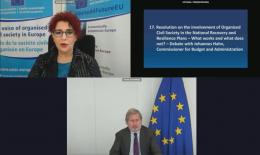
Reconstruction after the pandemic must be an opportunity to rebuild Europe on a new foundation of democratic participation. It would be a huge mistake if the fate and future of so many were to be decided by so few, the EESC 2021 Civil Society Days heard.
The projects which took home the prize are just a snapshot of the immense efforts undertaken by countless civil society organisations, companies and individuals on the ground, demonstrating that without them the price paid for the pandemic would be much higher
Comitetul Economic și Social European (CESE) a adoptat o rezoluție care subliniază că organizațiile societății civile organizate pot aduce o contribuție inestimabilă la planurile naționale de redresare și reziliență și trebuie să aibă un cuvânt de spus în acest proces.
The forthcoming Conference on the Future of Europe (CoFoE) is a sign of new thinking at EU level, bringing citizens right into the heart of policy-making with concrete power to drive systematic change,said Commission Vice-PresidentDubravka Šuica at the EESC Plenary.
23 projects from the EU and the UK have received the award for their outstanding contribution to fighting COVID-19 and its disastrous consequences.
The European Economic and Social Committee (EESC) announced the laureates of its Civil Solidarity Prize, launched in 2020 as a one-off award with the theme "Civil Society against COVID-19".
The European Economic and Social Committee (EESC) and the European Commission believe that the clean energy transition must be at the heart of the post-COVID-19 European Union and that now is the time to accelerate implementation of green measures for economic recovery.
For the first time after the signature of the EU-UK Trade and Cooperation Agreement Michel Barnier, Head of the European Commission Task Force for Relations with the United Kingdom, expressed publicly his views on the text during a debate at the European Economic and Social Committee (EESC) January plenary session. "This agreement starts a new era of our relationship with the UK, but we will have to face together a number of issues in the future", said Barnier.
Portugal'sPrime Minister,António Costa, participated in the European Economic and Social Committee's plenary session on 27 January to present the priorities of the Portuguese presidency of the EU. Portugal has pushed the social agenda up to the top of its presidency's programme and asked the EESC to provide its expertise on seven key opinions for the EU's future.
More clarity, greater financial transparency, strict rules on harassment and stronger sanctions for non-compliance. On 28 January 2021, the members of the European Economic and Social Committee (EESC) voted for major changes to their Code of Conduct. This is the first milestone in the reform of the Committee that the new EESC leadership is undertaking.