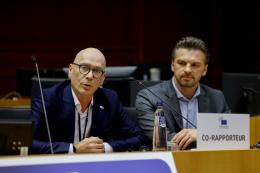
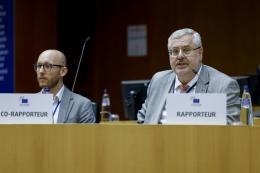
At its April plenary, the European Economic and Social Committee (EESC) adopted an exploratory opinion requested by the European Commission to gather input from civil society on the impact of the metaverse on society. The document, which examines the business environment, working conditions and development of civil society, suggests that the metaverse will bring with it both opportunities and risks that the EU must address rapidly to create an ethical, safe, and inclusive virtual environment for all.
În sesiunea plenară din aprilie a Comitetului Economic și Social European (CESE) a fost adoptat un aviz privind factorii-cheie pentru tranziția către un sistem de transport durabil pe termen lung.
On 9 May, the European Union will celebrate Europe Day 2023, a moment to commemorate the Schuman Declaration on 9 May 1950. To mark the special occasion, the EU institutions, including EU delegations and representations worldwide, will organise a wide range of online and on-site activities, providing citizens with the opportunity to discover and experience the European Union.
O dezbatere organizată de Comitetul Economic și Social European (CESE) a arătat că este esențial să se adapteze piața europeană a energiei electrice pentru a depăși fragilitatea acesteia, dependența mare de gaze, pentru a oferi în sfârșit consumatorilor și întreprinderilor din UE energie fiabilă și la prețuri accesibile.
With populism and authoritarianism on the rise across Europe, civil society organisations face growing hostility. Battling with financial constraints, smear campaigns, political attacks and legal and administrative obstacles, they urgently need reinforced support on all fronts to be able to play their key role of making our societies more open, more accountable and just.
Comitetul Economic și Social European (CESE) trage un semnal de alarmă și atrage atenția asupra faptului că avantajele digitalizării sistemului energetic se vor materializa numai dacă se elimină birocrația, dacă consumatorii sunt încurajați să joace un rol activ și dacă se alocă fonduri pentru perfecționarea lucrătorilor.
In its March plenary, the European Economic and Social Committee (EESC) adopted an opinion urging the European Institutions to address the fragmented implementation of foreign policy sanctions across Member States. The EESC is concerned about the inconsistency in standards and in the application of sanctions in national legislation, and is calling for immediate action to protect humanitarian aid and journalists in sanctioned regimes.
Mario Monti, former EU commissioner for competition and Prime Minister of Italy, will be the keynote speaker at the EESC event "Towards a Net Zero Industrial Future: Harnessing the Power of the Single Market", which will be held on 4 April to mark the 30th anniversary of the single market.
Amid a projected rise in the number of people at risk of poverty, adequate minimum income is a necessary condition to ensure a dignified life for many Europeans. To make sure it is available to all those who need it, Member States should put in place transparent and non-discriminatory criteria for people to obtain it.