
European Economic
and Social Committee
Delphi Economic Forum 2026: discussing Europe’s place in a changing world order
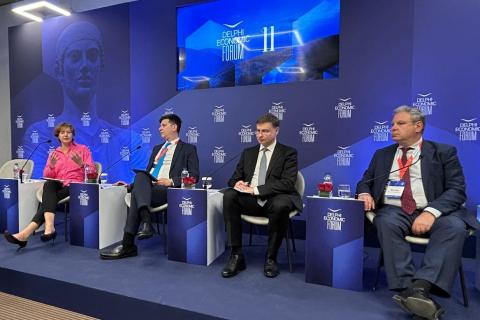
At this year’s Delphi Economic Forum, an EESC Employers' Group delegation, led by President Sandra Parthie and composed of members Winand Quaedvlieg, Marcin Nowacki, Michal Pinter, Kristi Sober, and Katalin Sule, joined political, business, and academic leaders to talk about economic growth, geopolitics, and sustainability.
As an institutional partner of the Forum, the Employers' Group members took the stage to discuss how to "strengthen EU Competitiveness and paths to an Innovative and globally ambitious Europe".
They highlighted that the EU has to do some homework to foster its competitiveness, such as rather urgent regulatory simplification, which is not a technical exercise, but an economic imperative. Simpler rules and stronger enforcement help turn EU objectives, from clean technologies to digitalisation, into viable business projects. Importantly, better implementation at national level is essential to prevent new layers of fragmentation from re‑emerging.
Our message to the distinguished forum participants was that affordable and reliable energy is a prerequisite for industrial competitiveness, and that high energy costs continue to weigh heavily on European manufacturers, especially in energy-intensive sectors. Our message was also, that Europe remains open to business and in particular to a rules-based trading system. Trade is in the European DNA, we are a trusted and reliable trading partner, and we are successfully concluding new trade agreements. Similar to our trading partners, we of course also need to safeguard our economic security and being mindful of dependencies.
Employers' Group President, Ms Sandra Parthie was also invited to contribute to an exchange on "The Future of the European Gig Economy", and "Europe in the Platform Economy: Competitiveness, Innovation and Regulation". She underlined that platform work thrives on flexibility and innovation, and regulation must protect workers without undermining genuine self‑employment or entrepreneurship.
At the conclusion of the Forum, President Parthie also spoke at the working dinner "At a crossroads: shaping Europe’s economy in 2026 and beyond", alongside Mr Valdis Dombrovskis, Commissioner for Economy & Productivity, Implementation & Simplification, where she highlighted that the EU is faced with a consistent productivity growth problem, and that improving the enforcement of the Single Market rules is a core task for the European executive. She underlined that the competitiveness of European businesses is inextricably linked to the availability of affordable energy, and it should therefore be a priority to invest in the European infrastructure for renewable and low-carbon energy production as well as energy storage.
Overall, the message from Delphi was clear: systemic rivalry across the globe increases. European leaders have to show agency, provide political answers and an economic framework that keeps Europe at the table and respected as a serious global actor. Regarding its own processes, it has to step up coherence and speed to not only react or keep up but to shape international developments.