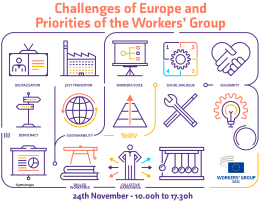
The Workers' Group is organising an extraordinary meeting on the current challenges for Europe and the priorities of the Workers' Group in this framework.
NAT/SDO online conference organized jointly with the German Council Presidency
Event type
Conference
Location
14:00 - 16:45
Brussels
Belgium
The conference will explore the role of European Civil Society in using digitalization in a way that it enables and drives sustainability to support the European Green Deal and the EU sustainable recovery.
Representatives of the European and Georgian Domestic Advisory Groups (DAGs), set up under the Trade and Sustainable Development Chapter of the Association Agreement between the European Union and Georgia, held their fifth joint meeting virtually on 9 July 2020.
Joint side event by the EESC and the Government of Slovenia at the High Level Political Forum (HLPF)
Event type
Webinar
Location
2.00-3.00 p.m. | Live on Twitter @EESC_SDO
The world is facing a climate emergency causing unprecedented economic, social and environmental challenges. Ambitious policy and action are necessary at all levels to accelerate a just transition to a sustainable future, while leaving no one behind. This is particularly relevant in the context of the COVID-19 pandemic, which has exposed the fragility of the current system. ► Watch again
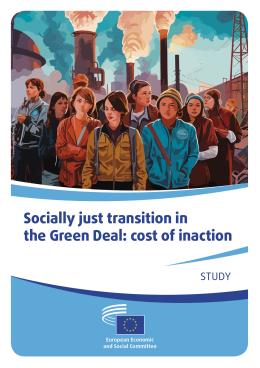
The study assesses how a prospective EU Just Transition Directive (JTD) could shape the social and employment outcomes of the European Green Deal. Drawing on literature review, stake-holder interviews, foresight-based PESTEL scenario building and partial-equilibrium projections, it develops business-as-usual, as well as weak and strong JTD scenarios to 2045. The scenarios focus on seven Member States representing diverse welfare and production regimes.
This publication marks the EESC’s renewed call for an EU Blue Deal in 2025, incorporating into the Declaration the new recommendations adopted since the launch of the call in October 2023.
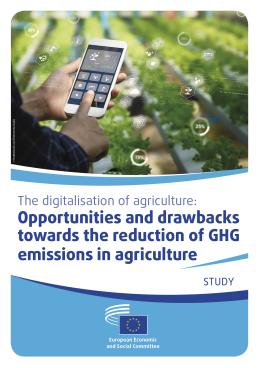
Opportunities and drawbacks towards the reduction of GHG emissions in agriculture
This study evaluates the environmental, social, and economic impacts of digitalisation based on a literature review and case studies in Estonia, Germany, Romania, and Spain
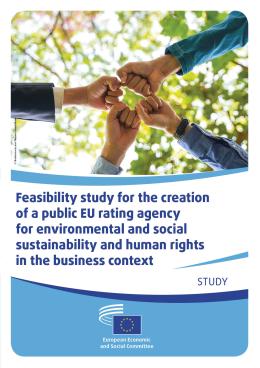
This report proposes the creation of a Public EU Rating Agency focused on environmental and social sustainability and human rights, aiming to support EU sustainability efforts by setting standards, accrediting auditors, and centralizing data
On 8 June 2022 the Consultative Commission on Industrial Change (CCMI) celebrated its 20th anniversary with a conference focused on the challenges of today and the prospects for tomorrow. This publication is a record of the occasion and a commemoration of what CCMI has achieved since joining the EESC.