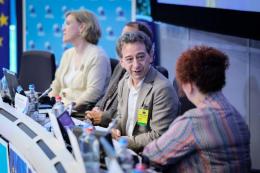
At its July plenary, the European Economic and Social Committee (EESC) argued that the new Trade and Technology Council (TTC) can become an innovative tool for both the EU and USA to work together towards a safer and more prosperous world, based on the principles of sustainable development and democratic values.
The European Commission should place greater focus on the long-term development of an EU able to better withstand geopolitical upheavals, counter their negative economic and social impacts and ensure that sustainable development guides its policies, the European Economic and Social Committee (EESC) has said in a resolution on the EU's priorities for 2023.
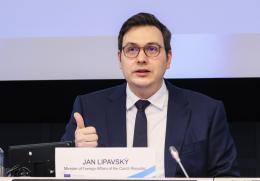
Ministrul ceh de externe, Jan Lipavský, a participat la o dezbatere organizată cu ocazia sesiunii plenare din iulie a Comitetului Economic și Social European (CESE), în cadrul căreia s-au discutat prioritățile Președinției cehe a Consiliului Uniunii Europene în al doilea semestru al anului 2022.
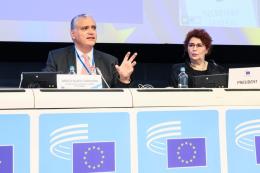
At the July plenary session of the European Economic and Social Committee (EESC), its president Christa Schweng and the newly elected president of the European Committee of the Regions (CoR) Vasco Alves Cordeiro discussed renewed prospects for joint action and cooperation between the two committees.
At its July plenary, the European Economic and Social Committee (EESC) debated the Commission's draft directive to tackle gender-based violence and gender equality in presence of Cristina Fabre of the European Institute for Gender Equality. The Committee adopted two opinions with recommendations for making the legislation more effective in combatting such an issue of epidemic proportions and demanded for its inclusion in the list of EU crimes.
Conferința la nivel înalt organizată la Riga de Comitetul Economic și Social European (CESE) a tras un semnal de alarmă cu privire la criza locuințelor accesibile ca preț și a avertizat că a sosit momentul ca UE să ia măsuri pentru a le permite europenilor să răspundă acestei nevoi fundamentale, în prezent și mai greu de satisfăcut, ca urmare a creșterii prețurilor la energie și a războiului din Ucraina.
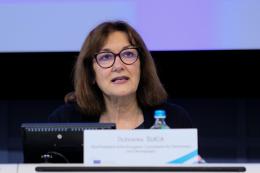
În cadrul sesiunii plenare din iunie a Comitetului Economic și Social European, președinta CESE, Christa Schweng, și vicepreședinta Comisiei Europene, Dubravka Šuica, au fost de acord că, după un an de dezbateri privind viitorul UE, este esențial acum să se ofere europenilor măsuri specifice de monitorizare.
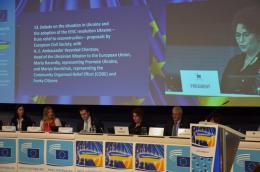
The European Economic and Social Committee (EESC), just a week ahead of the EU Council Summit, adopted its second Resolution on Ukraine, strongly supporting the country's unconditional candidate status to the EU. The European civil society will be working hand in hand with Ukraine for Ukraine on the reconstruction of the country delivering a stronger, greener, more resilient and sustainable European partner.
With the Declaration of Digital Rights and Principles and the Data Act, the EU is taking two more steps towards the creation of a digital space that puts people at its centre, a debate at the EESC's June plenary highlighted.
Key industrial sectors in Europe made the case for a more data-driven and future-oriented response to overcome the disruption arising from Covid, Russian aggression, the energy and climate crises, and industrial and social transformation.