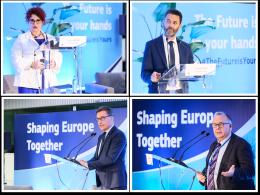
The European Economic and Social Committee (EESC) held a conference entitled Shaping Europe Together on Thursday 24 February. The purpose of this conference, organised with a view to the conclusion of the Conference of the Future of Europe, was to wrap up work done so far by the Committee and to discuss the latest state of the affairs, challenges ahead and ambitions for the future.
At its plenary session on 24 February, the European Economic and Social Committee (EESC) presented its opinion entitled 'Fit for 55': delivering the EU's 2030 Climate Target on the way to climate neutrality. The EESC has put forward concrete proposals to help accelerate the energy transition so as to enable the EU to reduce net greenhouse gas emissions by at least 55% by 2030.
As a result of the digital transition, platform work is spreading rapidly, shaping a new form of employment and affecting millions of workers. The EESC, in the hearing on the “Working conditions of platform workers package”, highlighted the potential risks and how these challenges should be met by the Directive proposed by the European Commission. The package was welcomed by the participants, who raised the need for a common legal framework, given the diversified reactions and practices applied by the Member States when it comes to platform labour.
Recent initiatives on regulating AI systems and digital services represent a significant turning point and mark a growing recognition that the negative impacts of digitalisation need to be urgently addressed. However, there are still many legislative loopholes and gaps that need to be bridged to secure a safe online space that will respect and protect human dignity and not merely serve as the profit-making arena for Big Tech
Key stakeholders of Europe's tourism sector speaking in a debate at the EESC February plenary expressed support for the measures called for by a new EESC report to revive and future-proof the industry.
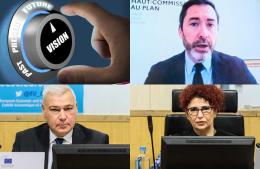
The conference on Strategic foresight: a vision for the future of Europe, held by the European Economic and Social Committee (EESC) in the framework of its External Relations Section (REX) meeting, highlighted the emerging importance of identifying different possible futures, and explored pathways to tackle challenges and seize opportunities. The participants called for attention to civil society interests and concerns, underlining that these should be reflected in the Strategic Foresight Reports drafted by the Commission.
At the request of the French Presidency of the Council of the EU, in the opinion on Food security and sustainable food systems adopted at its plenary session on 19 January 2022, the European Economic and Social Committee (EESC) identified the key levers for sustainable and competitive EU food production and for reducing dependence on imports while increasing the EU's protein autonomy.
This webinar, hosted by the European Economic and Social Committee (EESC), highlighted the views of civil society organisations on the future of European industry, pointing out that sources of clean energy were essential to a successful transition to a carbon-neutral economy.
Social dialogue is an important tool for ensuring health and safety at work. However, in the face of changes brought to the world of work by the digital and green transition and the health crisis, social dialogue will have to be strengthened across Europe. It should be complemented by more robust rules on musculoskeletal disorders and psychosocial risks leading to major work-related illnesses such as heart conditions, stroke, cancer and depression
In an exploratory opinion requested by the French presidency to the Council of the EU and adopted in January 2021, the European Economic and Social Committee (EESC) calls on the European Commission (EC) to consider the substantial benefits that the outermost regions (ORs) can bring to the future of Europe. The EC should also take appropriate measures to ensure that the ORs don't miss the post-COVID recovery, and don't fall behind in terms of the climate, social and digital transitions.