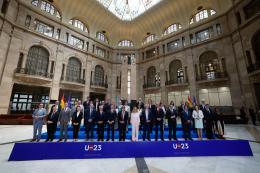
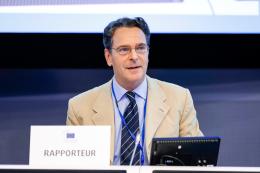
On 13 and 14 July, President Röpke participated in the first informal meeting of Ministers of Labour and Social Policies of the European Union (EPSCO) under the Spanish Presidency, focusing on "Social dialogue as a tool of democratic legitimacy for a social, green and feminist Europe".
On 17 July, EESC President Oliver Röpke together with the EESC delegation, Peter Schmidt and Antje Gerstein held a meeting with UN Secretary-General António Guterres, in context of the UN High Level Political Forum taking place in New York.
The European Economic and Social Committee (EESC) welcomes the European Commission's strategy on the energy transition of the EU fisheries and aquaculture sector in an opinion requested by the Spanish Presidency and adopted at the July plenary.
The EESC adopted an opinion at its July plenary emphasising the need for a comprehensive and coordinated approach to raw materials policies. It proposes expanding critical materials lists, ensuring fair energy prices, simplifying permits, prioritising recycling and promoting capacity building in EU raw materials policies.
Într-un aviz adoptat în sesiunea plenară din iulie, Comitetul Economic și Social European (CESE) a subliniat impactul puternic al prețurilor ridicate asupra economiei UE și a invitat guvernele naționale să pună în aplicare măsuri pentru a ajuta familiile vulnerabile și sectoarele esențiale.
Today, the EESC decided to start a pilot project to implement the EU Youth Test in its opinions and to set up a new Youth Group, thus delivering on important priorities of President's Röpke political manifesto.
The EESC has suggested that products which cannot be repaired should not be marketed in Europe, and that merely requiring producers to inform consumers when a product cannot be fixed is not enough.
Despite being recognised as a constitutional principle of the EU, participatory democracy in Europe is still largely unstructured, with no formal institutional agreements that would allow citizens and civil society organisations to directly contribute to the development of EU policies