
European Economic
and Social Committee
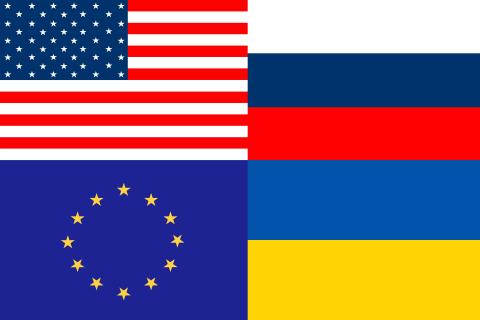
By the EESC Workers' Group
As the continent enters the fourth year of what was meant to be Vladimir Putin's 'three-day special military operation' to overthrow the Ukrainian government, nullify Ukraine’s independence and ensure its return as a vassal state, the war rages on. Between half a million and 1.5 million people have been killed or injured, vast areas of land have become unusable and entire cities lie in ruins. For four years, Ukrainians have valiantly fought against a numerically superior enemy, enduring war crimes, constant attacks on civilians and blackouts in the depths of winter.
The continuation of the war raises difficult questions about the future. With U.S. support dwindling in recent years, fuelled by the Trump administration's worldview centred on spheres of influence, Europe has become Ukraine's main backer. Given Ukraine’s role as the frontline of European security, this support is driven not by charity, but by Europe's existential need.
At the same time, Chinese support and Russia's autarkic economy have blunted the impact of Western sanctions. Putin’s continued strategy of 'feeling forward' (driven largely by the lack of viable alternatives) is turning Russia into a Chinese economic vassal (even though the enmity between the two should not be underestimated). Russia, for its part, accuses the EU of obstructing ‘peace’ (which in practice would mean Ukrainian capitulation), and promises ‘no more wars’ if Russia and its interests are respected. This is hardly reassuring, as Russia’s interests tend to include entire or large parts of its neighbouring states, some of them within the European Union.
Moreover, Russia’s war economy provides little incentive for a return to peace now that its military is fully mobilised, while Trump’s own 'special military operations' legitimise Russia’s actions in what it considers its backyard. At the same time, although Ukraine has fought admirably against overwhelming odds, Western support has too often been sufficient only to keep it in the fight, but not enough to enable victory.
Despite all the geopolitical considerations, the war continues unabated and people are still dying. Ukraine must press forward on its EU accession path, and this should also prompt the EU to rethink both the accession process and its internal decision-making procedures. In a world shaped by strongmen, raw power and spheres of influence, the EU must stand its ground and show there is another way, and that there is hope for normal countries to survive without becoming vassals of larger powers.
Securing a sovereign and independent future for Ukraine is central to this vision. Only by doing so can the EU use its influence to improve people’s lives within Ukraine itself, strengthening civil and social dialogue, supporting social partners and protecting fundamental rights. Although sometimes called into question during wartime, social dialogue and collective bargaining remain essential to societal peace and strength. They play a key role in mobilising social forces within the country and ensuring support for the country's defence efforts.