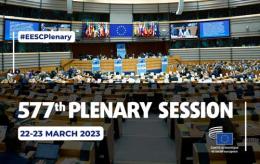
On 23 March, the European Economic and Social Committee adopted two opinions on the Commission's latest proposals to further develop the EU's Capital Markets Union. Regarding the Listing Act, the Committee recommends that the full listing documentation be published in the national languages to empower local retail investors and helpthe development of a national retail investment base.
The Social Progress Protocol, proposed during the Conference on the Future of Europe (CoFoE), gives precedence to social, workers' and trade union rights when they are in conflict with economic freedoms. However, while everyone agreed that social rights and economic freedoms can co-exist, support for making the protocol primary EU law is far from unanimous, with diverging views among the social partners and in the academic community, an EESC hearing confirmed
President of the European Economic and Social Committee, Christa Schweng, highlights the requirements for Europe to become globally more competitive and sustainable.
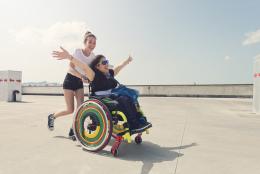
Persistent health inequalities are a huge factor behind the twofold higher mortality rate of people with disabilities, who on average die 10 to 20 years earlier than people without a disability. At the top of the list of barriers creating such inequalities are exorbitant treatment costs, inaccessible transport and health facilities, and stigma – but also a healthcare workforce that lacks proper training on disability issues.
The EESC included a youth delegate in its UNFCCC COP delegation for the first time in 2021 and committed to repeating this experience in the years to come. The EESC youth delegate to COP has a mandate of two years and at the end of each mandate a transparent and open selection process is carried out to designate the new delegate. The new EESC youth delegate to the COP has just been selected!
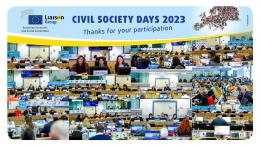
The EESC's Civil Society Days 2023 ended on 3 March with a set of proposals to not only protect but also expand the EU's civic space and ensure younger generations a solid foundation where they can build a vibrant civil society.
This year's Civil Society Days will shine a light on the fundamental role of civil society organisations in ensuring and safeguarding both social cohesion and resilient democracy in Europe.
On 27 and 28 February 2023, the European Economic and Social Committee (EESC) and the European Commission are co-hosting the 6th European Circular Economy Stakeholder Conference, welcoming altogether some 1,000 circular economy practitioners and specialists to debate new regulations and policies, showcase best practices of EU-funded projects and schemes, explore innovations and look for partners willing to launch on joint projects.
At its plenary session on 24 February, the EESC adopted an opinion on the Commission's Communication outlining orientations for a reform of the economic governance framework. While the EESC agrees on the need for a swift agreement ahead of the Member States' budgetary processes for 2024, it also stresses that many details are yet to be finalised.