
Regno Unito

This page is also available in:

Il 24 dicembre 2020, al termine di un negoziato lungo e complesso, l'Unione europea e il Regno Unito hanno raggiunto un accordo sugli scambi commerciali e la cooperazione. A partire dal 1º gennaio del 2021 tale accordo è stato applicato in via provvisoria fino al completamento del processo di ratifica da parte del Consiglio e del Parlamento europeo. Come altri accordi di libero scambio stipulati di recente, anche l'accordo tra l'UE e il Regno Unito contiene disposizioni specifiche in materia di dialogo con la società civile. In quanto attore chiave di tale dialogo, il CESE ha quindi deciso in merito alle proprie strutture intese a promuovere le relazioni con il Regno Unito e la sua società civile (imprese, sindacati e altre organizzazioni), nonché in merito all'organo incaricato di monitorare l'attuazione dell'accordo.

Questo nuovo assetto, adeguato alla luce non solo dell'accordo concluso e delle nuove relazioni UE-Regno Unito, ma anche dei recenti sviluppi istituzionali in seno alla Commissione europea, prevede:

  • il comitato di monitoraggio UE-Regno Unito, successore politico del gruppo di monitoraggio Brexit e organo del CESE per il quale il Comitato potrà stabilire il proprio ordine del giorno e le proprie priorità, al fine di rispondere alle esigenze della nuova realtà;
  • il gruppo consultivo interno Regno Unito nel quadro dell'accordo sugli scambi commerciali e la cooperazione tra UE e Regno Unito, pilastro istituzionale della società civile per quanto concerne le relazioni commerciali tra le due parti.

Ora che le future relazioni tra i due partner sono state inquadrate in un accordo di partenariato di tale importanza e portata, il CESE è impegnato a svolgere il proprio ruolo per ottimizzare il potenziale di tale accordo, in particolare in relazione alla società civile del Regno Unito. Il CESE è determinato a mantenere stretti contatti con la società civile del Regno Unito dopo la Brexit, a incoraggiare il dialogo e gli scambi e a coinvolgere le organizzazioni della società civile nel processo decisionale sociale, garantendo in tal modo la tutela dei forti legami economici, sociali e politici creatisi nel corso di oltre mezzo secolo di appartenenza del Regno Unito all'UE.

  • In this opinion the EESC: 

    • provides guidance for an ambitious TCA review, recommending integral roles for EU and UK DAGs due to their practical insights and experience of the agreement's impacts;
    • calls for an enhanced regulatory cooperation on non-tariff barriers which will provide the biggest opportunity to improve the bilateral trade relations – closer alignment of regulatory systems reduces frictions and yields considerable benefits;
    • calls for mutual recognition of standards and improved mobility for services to reduce border friction, lower trading costs, and boost fair market access, growth and job creation on both sides;
    • insists on a ‘future-proof TCA’ by incorporating the youth perspective, progressively removing barriers to seizing new opportunities.
  • Published in
    Study
    63 pages

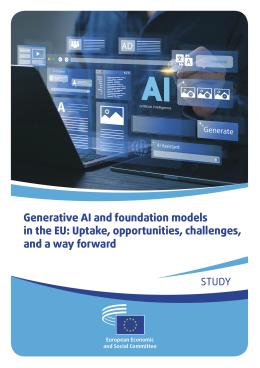
    Exploring the evolving landscape of generative artificial intelligence (GenAI) within the European Union, this study delves into technological advancements, market dynamics, and regulatory challenges. It highlights the EU’s position in the global GenAI ecosystem, revealing significant US dominance, while uncovering sector-specific opportunities and risks across industries such as automotive, renewable energy, and education.

  • The European Commission organised the third Civil Society Forum of the EU-UK trade and cooperation agreement (TCA) on 20 September 2024, at EESC premises, in Brussels.

    Participation was open to civil society organisations representing employers' organisations, workers' representatives, NGOs and academics.

    The agenda for this third meeting of the CSF included trade in goods, level playing field, regulatory cooperation, trade in services & energy.

  • The Domestic Advisory Groups (DAGs), set up under the EU-UK Trade and Cooperation Agreement (TCA) to advise on the implementation of the agreement, held their third meeting on 19 September 2024, in Brussels.

  • The EU DAG set up under the EU-UK TCA met ahead of the DAG-to-DAG meeting and the Civil Society Forum in preparation for these joint events. Exchanges focused on finalising the joint statement exercise and some anticipation on the discussions and opportunities that CSF would bring.

  • The 11th meeting of the EU DAG, which took place right after European elections and ahead of UK general election, was dedicated to members’ presentations on pressing ongoing issues, including CBAM, concerns around labour rights LPF and non-regression, the sand eel dispute and the transport of live animals and common veterinary.


  • Luísa Santos, the new Chair, welcomed the EU DAG to its 10th meeting, putting forward some actions and proposals to give more visibility to future meetings and improve cooperation with UK DAG. In the light of this approach, EU DAG members discussed the impact of recent developments in EU-UK relations as well as the priorities for the TCA review. 


  • The 9th meeting of the EU DAG set up under the EU-UK TCA, the last one chaired by Tanja Buzek (now vice-chair), was mostly dedicated to a debriefing on the DAG-to-DAG meeting and the 2nd Civil Society Forum (CSF) held in London on 6 and 7 November 2023. 


  • Published in
    97 pages

    EESC Own-initiative opinion on EU-UK Youth Engagement and technical report in support of the own-initiative opinion

  • Strengthening ties between young people and youth organisations in the European Union and the United Kingdom will have tangible positive effects on a generation of Europeans disproportionately affected by the consequences of Brexit, according to the European Economic and Social Committee (EESC).