Europa

This page is also available in:

In Europa, il CESE intrattiene relazioni con le parti sociali e le organizzazioni della società civile dei Balcani occidentali, del vicinato orientale, degli Stati EFTA-SEE (Islanda, Liechtenstein e Norvegia) e del Regno Unito.

Il comitato di monitoraggio Balcani occidentali, organismo interno permanente del CESE, rappresenta lo strumento principale per il coordinamento delle attività del Comitato nella regione. Tra le attività del comitato di monitoraggio rientra il forum della società civile dei Balcani occidentali, che si svolge ogni due anni.

Il CESE collabora inoltre bilateralmente con i paesi dei Balcani occidentali che hanno avviato i negoziati di adesione e con la Turchia, attraverso organismi specializzati creati sulla base di accordi di associazione tra questi paesi e l'UE: l'obiettivo di questi comitati consultivi misti è quello di coinvolgere le parti sociali e le organizzazioni della società civile nel monitoraggio dei processi di preadesione e di riforma in vista di una possibile adesione all'UE. Ciascun organismo è formato da un numero uguale di membri del CESE e del paese partner e si riunisce generalmente una o due volte l'anno.

Il CESE ha inoltre istituito un comitato di monitoraggio Vicini dell'Est europeo, un organismo interno incaricato di rafforzare le relazioni con la società civile dei paesi della regione (Armenia, Azerbaigian, Bielorussia, Georgia, Moldova e Ucraina).

I principali meccanismi di cooperazione con l'Armenia, la Georgia, la Moldova e l'Ucraina sono costituiti dalle piattaforme della società civile, che consentono alle organizzazioni della società civile dell'UE e del paese partner di monitorare l'attuazione degli accordi dell'UE con tali paesi e di elaborare raccomandazioni destinate alle autorità competenti. Inoltre, nel 2022 l'Ucraina e la Moldova sono diventate paesi candidati.

Per quanto riguarda la Bielorussia e la Russia, si stanno sviluppando relazioni con quelle organizzazioni della società civile che sono ancora libere di operare, la maggior parte delle quali sono stabilite sul territorio dell'UE. Il CESE ritiene importante mantenere vivo il dialogo, nell'attesa che le condizioni migliorino in futuro.

Lo Spazio economico europeo (SEE) riunisce gli Stati membri dell'UE e i tre Stati EFTA-SEE (Islanda, Liechtenstein e Norvegia) in un mercato interno in cui beni, servizi, capitali e persone possono circolare liberamente. Il CESE fa parte del comitato consultivo SEE, nel cui quadro le questioni di interesse comune sono discusse con i rappresentanti delle parti sociali degli Stati EFTA-SEE.

Infine, il CESE dispone di un comitato di monitoraggio UE-Regno Unito che ha il compito di monitorare le relazioni tra l'UE e il Regno Unito di Gran Bretagna e Irlanda del Nord dal punto di vista della società civile. I suoi lavori sono concentrati in particolare sull'attuazione dell'accordo sul recesso del Regno Unito dall'UE e del protocollo su Irlanda/Irlanda del Nord, in merito al quale intrattiene il dialogo con le organizzazioni della società civile del Regno Unito, nonché sull'attuazione dell'accordo sugli scambi commerciali e la cooperazione tra l'UE e il Regno Unito, al cui riguardo il comitato di monitoraggio UE-Regno Unito coopera con il gruppo consultivo interno dell'UE nell'ambito dell'accordo sugli scambi e la cooperazione UE-Regno Unito.
  • -

    The first and inaugural meeting of the EU-Armenia Civil Society Platform (CSP) was held on 1st September 2022 in Yerevan. The CSP complements the political bodies existing within the framework of the EU-Armenia Comprehensive and Enhanced Partnership Agreement, and it allows civil society organisations from both sides to monitor the implementation process and prepare recommendations to the EU-Armenia Partnership Council and other relevant bodies both in Armenia as well as in the EU.

    The CSP is made up of members from both Parties, representing the EESC and large European civil society networks, on the one side, and civil society organisations from Armenia, on the other side.

    During the meeting, a debate focused on assessing the state of play of the implementation of the EU-Armenia Comprehensive and Enhanced Partnership Agreement and the members of the CSP discussed working methods and future activities of the Platform.

  • The 12th meeting of the EU Domestic Advisory Group under the EU-Ukraine DCFTA took place via a videoconference on 6 September 2022. Please click on the programme tab to consult the topics on the agenda.

  • The 9th meeting of the EU-Georgia Civil Society Platform (CSP) was convened on 28 June 2022 in Tbilisi, Georgia. 

    During the meeting, an exchange with Georgian and EU authorities was held to assess the European perspective of Georgia and the implementation of the EU-Georgia Association Agreement/DCFTA. Furthermore, the participants discussed the economic and social impact of the war in Ukraine on Georgia and the EU, the role of civil society in the post-war recovery and human rights in the face of war and crisis. A joint declaration, prepared by both sides, was discussed and adopted.

  • 12 July 2022 - Hybrid - Room JDE52
    Event type
    Meeting

    The 2nd meeting of the All DAGs (Domestic Advisory Groups) takes place on 12 July 10 a.m. in a Hybrid format at the EESC premises (room JDE52). This is very timely following the recent adoption of the European Commission Communication on the Trade and Sustainable Development Review (TSD). This meeting will look at the state of play and future of the Domestic Advisory Groups (DAGs) under the EU Free Trade Agreements, as well as the important role of trade and sustainability in promoting fair and inclusive growth worldwide and resilient supply chains.

  • The 9th meeting of the EU-Moldova Civil Society Platform took place on 24 May 2022. During the meeting, a debate focused on assessing the state of play of the implementation of the EU-Moldova Association Agreement. The Platform also discussed the application of Moldova for the status of EU membership candidate.

  • At this 3rd meeting of the EU DAG set up under the TCA, members further discussed and assessed ongoing implementation issues. T

  • The 11th meeting of the EU-Ukraine Civil Society Platform took place on 20 April 2022. During the meeting, an exchange between authorities and members of the civil society platform was held with special focus on the unprovoked and unilateral armed aggression initiated by the Russian Federation against Ukraine on its independent and sovereign territory. A joint declaration, prepared by both sides, was discussed and adopted.

  • 30th meeting of the European Economic Area (EEA) Consultative Committee

    The next meeting of the European Economic Area Consultative Committee's will held in Bergen (Norway) on 11 May 2022. Reports and resolutions are prepared on two subjects:

    • a) The social aspects of the Fit for 55 package
    • b) The challenges and opportunities of increased use of artificial intelligence in working life
  • Breaking down the silos

    The Forum aimed to break down the silos and enable inclusive and interactive debates between institutions, academia and civil society, all on an equal footing. The event covered topics relevant to trade and sustainable development (TSD) – from substantive rights through monitoring to enforcement and much more. The ambition was to feed innovative ideas and concrete recommendations to the ongoing reflections on the future of EU TSD policy, in the double context of the review of the 15-point action plan and recent trade and sustainability developments outside the EU.

  • Event type
    JCC Meeting

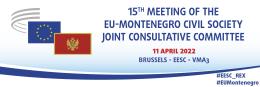
    For the 15th time, the European Economic and Social Committee (EESC) and Montenegro held the Civil Society Joint Consultative Committee (JCC). It took place in Brussels and tackled issues such as: Current state of play in EU-Montenegro relations including 2021 Montenegro Report / Revised enlargement methodology – Cluster 1: The Fundamentals of the Accession Process, with a special focus on Economic Criteria, Public procurement, Statistics and Financial Control and the response to the COVID-19 pandemic / Overview of the civil society situation in Montenegro.

    A joint declaration was adopted at the meeting and distributed to all relevant EU institutions, as well as to the Montenegrin authorities.