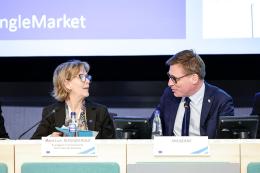
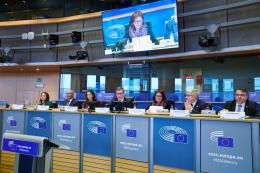
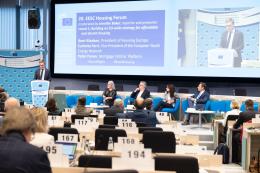
Despite progress in gender equality, millions of women across Europe still face violence, discrimination and barriers to equal opportunities. From under-representation in leadership to the alarming rise in gender-based violence, urgent action is needed. The European Economic and Social Committee (EESC) High-Level Forum on Women’s Rights brought together leading voices to address these pressing issues and outline key priorities ahead of the upcoming UN Commission on the Status of Women session.
Expanding across borders in the EU means navigating a maze of conflicting VAT rules and paperwork, driving up costs. Small and medium-sized enterprises (SMEs), in particular, face disproportionate compliance burdens, making it harder to scale up and compete. To cut red tape and boost competitiveness, the EESC calls for urgent reforms in two opinions adopted during its February plenary, building on the Letta and Draghi reports. Proposals include harmonised financial regulations, AI-driven reporting and a coordinated industrial policy.
This year, the European Economic and Social Committee (EESC) is awarding its flagship Civil Society Prize to non-profit projects dedicated to combating the harmful polarisation of European society.
Artificial Intelligence is transforming the world of work at an unprecedented pace, bringing both opportunities and challenges for workers, businesses and policymakers. On 3 February, the European Economic and Social Committee (EESC) and the International Labour Organization (ILO) held a joint high-level conference entitled ‘Social Justice in the Digital Era: AI’s Impact on work and society’, gathering over 300 experts, policymakers and social partners and civil society representatives to discuss how AI can contribute to inclusive labour markets, decent work and social justice.
With artificial intelligence reshaping the workplace, it is crucial to continue promoting human-centric AI and advocating for policies that balance strong AI development in Europe with social justice and workers’ rights, a high-level debate at the EESC heard.
Young people in the Mediterranean region must be included in every step of the way, from policy-making to implementation. They shape not only policies but also life, as highlighted in the debate held by the European Economic and Social Committee (EESC).
On the occasion of the 20th anniversary of the EESC's Liaison Group, the founders and current members of the Group called for intensive action to defend European democracy, open public space and a just Europe.
În cadrul sesiunii sale plenare din decembrie, Comitetul Economic și Social European (CESE) a organizat primul său Forum privind locuințele, subliniind nevoia urgentă de locuințe decente, durabile și la prețuri accesibile în întreaga Uniune Europeană. Forumul a reunit părți interesate la nivel înalt pentru a aborda actuala criză a locuințelor și pentru a explora posibile soluții.
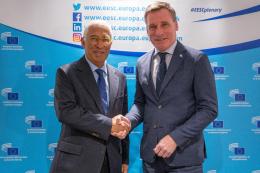
António Costa, the new President of the European Council, used his first appearance at the European Economic and Social Committee (EESC) to share his key priorities for the EU. He highlighted competitiveness as the basis for Europe’s future prosperity and reiterated his commitment to combining competitiveness with social rights to secure a sustainable future for Europe. In line with this, EESC President Röpke highlighted that the EU needs to strive for a competitiveness works for the many, not the few.
Conferința la nivel înalt a CESE, care a avut loc la Budapesta, a îndemnat noua Comisie Europeană și statele membre ale UE să elaboreze un cadru de politică cuprinzător, care să stabilească obiective comune și măsurabile pentru a aborda parcursul bolilor rare și pentru a intensifica și mai mult cooperarea europeană.